
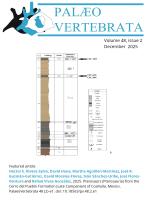
Abstract book of the 18th Conference of the EAVP
Pterosaurs from Coahuila
Miocene Bovidae (Mammalia) of the Siwaliks: Hypsodontinae and Bovinae
Les sélaciens du Miocène de la région de Montpellier
Contribution à l'étude des genres Gliravus et Microparamys.
Muridae du Pliocène supérieur d'Espagne et du midi de la France.
Eocene (57) , Quercy Phosphorites (38) , Systematics (32) , Rodents (29) , Mammalia (27) , Rodentia (25) , Miocene (25)
|
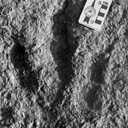
Nouvelles données sur les Ichnites de dinosaures d'El Bayadh (Crétacé Inférieur, Algérie)Mostefa Bessedik
Published online: 16/12/2008 |
|

|
Observations sur l'anatomie crânienne du genre Palaeotherium (Perissodactyla, Mammalia): mise en évidence d'un nouveau sous-genre, FranzenitheriumJean-Albert RemyPublished online: 01/12/1992Keywords: Palaeotherium; Paléogène; Perissodactyla; skull anatomy; Systematics https://doi.org/10.18563/pv.21.3-4.203-224 Abstract The skull remains referred to the genus Palaeotherium are recorded and described. Biometrical tests are made to elucidate intrageneric allometric relationships and to allow comparisons with various other perissodactyls. Apart from the well known shortness of post canine diastems and deepness of the narial opening, the genus is characterized by a great lengthening of the splanchnocranium, owing to a spreading of the post-orbital facial region, by a reduced area of the eye-socket and by the prevalence of the temporal muscle with regard to the masseter; this original shape of the masticatory apparatus needs to be related to the morphology of the jugal teeth and particularly to their asymmetrical semi-hypsodonty. PV article infos Published in Vol. 21, Fasc. 3-4 (1992) |
|

|
Sur les empreintes de pas des gros mammifères de l'Eocène supérieur de Garrigues-ste-Eulalie (Gard)Paul EllenbergerPublished online: 01/10/1980Keywords: Eocene; Euzet; Footprints; Ichnofauna https://doi.org/10.18563/pv.9.ext.37-78 Abstract Is hereby described an impressive lchnoiauna belonging to the Lower to Middle Ludian of the Gard (S. France). The slab, already cleaned over a length of 18 m, is located near the top of the Potamides aporoschema lacustrine limestone (Lower Ludian, Euzet zone). It is therefore older than the Célas sandstone deposit, and still more than the Melanoides albigensis and M. acutus marly limestone corresponding to the Upper Levels of the Ludian stage. Although biostratigraphically older than the La Débruge and Montmartre zone, the biotope shows already a sampling of very tall Artiodactyles, Perissodactyles and Carnivorous. One of the most « majestic ›› Artiodactyles, Anopolotheriipus lavocati, nov., points out a huge size type. To mention also among the Ichnotypes described, 10, the big Perissodactyle Palaeotheriipus similimedius, nov., and the big Carnivorous Hyaenodontipus praedator, nov. PV article infos Published in Vol. 9, Ext (1980) |
|

|
Types dentaires adaptatifs chez les sélaciens actuels et post-paléozoïques.Henri Cappetta
Published online: 01/09/1986 |
|

|
Contributions à l'étude du gisement miocène supérieur de Montredon (Hérault). Les grands mammifères. Avant propos.Bernard SigéPublished online: 15/11/1988Keywords: Editorial; Mammalia; Montredon; Upper Miocene https://doi.org/10.18563/pv.18.ext.1-2 Abstract Le Mémoire Extraordinaire 1988 de PALAEOVERTEBRATA regroupe dix articles consacrés au gisement à mammifères du Miocène supérieur de Montredon (Hérault), connu et classique depuis la fin du siècle dernier, et auquel est lié le nom du savant paléontologue lyonnais Charles Depéret. View editorial Published in Vol. 18, Ext (1988) |
|

|
Leptacodon nascimentoi n,sp., un nouveau Nyctitheriidae (Mammalia,Lipotyphla) de l'Eocène inférieur de Silveirinha (Baixo Mondego, Portugal)Carmen EstravisPublished online: 16/12/1996Keywords: Eocene; Leptacodon; Lipotyphla; Mammals; Nyctitheriidae; Portugal; Silveirinha https://doi.org/10.18563/pv.25.2-4.275-286 Abstract In this article is described a new species of Nyctitheriidae with primitive characters: Leptacodon nascimentoi n. sp. from the early Eocene of Silveirinha (Portugal). PV article infos Published in Vol. 25, Fasc. 2-4 (1996) |
|

|
The Gliridae (Mammalia) from the oligocene (MP24) of Gröben 3 in the folded molasse of southern GermanyUndine UhligPublished online: 28/12/2001Keywords: Biostratigraphy; Cyrena Beds; folded molasse; Germany; Gliridae; level MP 24; Mammals; Oligocene; Palaeoecology https://doi.org/10.18563/pv.30.3-4.151-187 Abstract This study describes four taxa of Gliridae from the Oligocene mammal locality Gröben 3: Gliravus tenuis BAI-ILO, 1975, Bransatoglis micio (MISONNE, 1957), B. planus (BAHLO, 1975) and B. heissigi n. sp. Gliravus tenuis from Gröben 3 is somewhat more advanced than the type population found in Heimersheim. This confirms previous research suggesting that Gröben 3 should be dated earlier than Heimersheim (MP 24). The first documented occurrence of B. mício around level MP 24 was found in Gröben 3. An abundance of tooth material from B. planus in Gröben 3 makes it possible, for the first time, to observe evolutionary stages within this species from MP 21 until MP 28. B. heissigi n. sp. is restricted to level MP 24. This species is located between B. mísonnei (MP 20 - 23) and Microdyromys praemurinus (MP 25 - 28). Within the lineage Bransatoglis bahloi - B. misonnei - B. heissigi, a decrease in size is noticeable. PV article infos Published in Vol. 30, Fasc. 3-4 (2001) |
|

|
Rongeurs du Miocène supérieur de Chorora, Ethiopie: Murinae, Dendromurinae et conclusions.Denis Geraads
Published online: 30/07/2001 |
|

|
Les oiseaux aquatiques (Gaviiformes à Anseriformes) du gisement Aquitanien de Saint-Gerand-le-Puy (Allier, France): Révision systématique.Jacques ChenevalPublished online: 01/11/1984Keywords: Aves; Early Miocene; Osteology; Palaeoecology; Systematics https://doi.org/10.18563/pv.14.2.33-115 Abstract Six orders of birds adapted to aquatic life are represented among the numerous avifauna of "Saint-Gérand-le-Puy": Gaviiformes, Procellariiformes, Pelecaniformes, Ciconiiformes, Phoenicopteriformes, and Anseriformes. The present study of this avifauna proposes several changes in systematics:- Procellariiformes: Puffinus arvernensis does not belong in Procellariidae but in Diomodeidae, and it is transferred to the fossil genus Plotornis previously described in the Middle Miocene of France. - Pelecaniformes: Phalacrocorax littoralis remains in Phalacrocoracidae; P. míocaenus is different from the modern species, and is transferred to the new genus Nectornis. Empheresula arvernensis, described in the Oligocene deposits of Gannat, seems to be present in Saint-Gérand-le-Puy too. Pelecanus gracilis shows many differences from the modern species, and belongs to the new genus Miopelecanus, - Ciconiiformes: Ardea formosa nom. oblit. is a synonym of Proardeola walkeri. - Anseriformes: a new species closely related to swans is described, and belongs to the fossil genus Cygnopterus, of the Middle Oligocene of Europe; this species is called C. alphonsi. The ecology of each species is suggested by comparison with that of its nearest living relatives, and by study of osteological adaptations. PV article infos Published in Vol. 14, Fasc. 2 (1984) |
|

|
Perutherium altiplanense, un Notongulé du Cretacé Supérieur du PérouLarry G. Marshall, Christian de Muizon
Published online: 30/11/1983 |
|

|
Les Otolithes de téléostéens du Miocène de Montpeyroux (Herault),France).Dirk Nolf and Henri Cappetta
Published online: 15/12/1980 |
|

|
Les Pseudosciuridae (Mammalia, Rodentia) de l'Eocène moyen de Bouxwiller, Egerkingen et Lissieu.Jean-Louis HartenbergerPublished online: 30/10/1969Keywords: Bouxwiller; cranium; Egerkingen; Middle Eocene; Rodents https://doi.org/10.18563/pv.3.2.27-64 Abstract The description of new material from three classic middle Eocene localities of western Europe permits the addition of details to the systematics of primitive Pseudosciurids. The cranial anatomy of Protadelomys cartieri (STEHLIN and SCHAUB) from Egerkingen is described here and compared to that of the Adelomyines from the late Eocene, until now the only ones known. The morphologic and biometric study of the dentition of P. cartieri compared to that of P. alsaticus n. sp. from Bouxwiller and P. Iugdunensis n. sp. from Lissieu, forms respectively older and younger than P. cartieri, permits the evolutionary tendencies of the group to be demonstrated and shows that notable differences in age exist between these localities. This ensemble of forms can constitute a valuable guide lineage in the establishment of a fine stratigraphy of the period. Other less well known lineages are present at Egerkingen along with P. cartieri. They can be related to genera that have been noted int he late Eocene. In conclusion, a criticism of recent zonation proposals, made by divers authors, completes this article. PV article infos Published in Vol. 03, Fasc. 2 (1969) |
|

|
Rongeurs nouveaux de l'Oligocène Moyen d'Espagne.Louis ThalerPublished online: 15/09/1969Keywords: Cricetidae; Oligocene; Pseudocricetodon; Rodents; Theridomys https://doi.org/10.18563/pv.2.5.191-207 Abstract Description of four new rodents from a recently discovered locality at Montalban. Theridomys crusafonti nov. sp. is considered as the ancestry of T. Iembronicus. Theridomys varian: nov. sp. includes «Theridomys» morphotypes and «Blainvilllimys» morphotypes; it could be ancestral to B. blainvillei. Pseudoltinomys nanus nov. sp. represents a new lineage paralleling in evolution that of P. gaillardi (which is equally found at Montalban). Pseudocricetodon montalbanensis nov. gen., nov. sp. designates a lineage of very small Cricetidae accompanying Eucricetodon. With these well defined new species and six others present in the locality, Montalban appears as the best faunal reference point within the biochronologic zone of La Sauvetat. PV article infos Published in Vol. 02, Fasc. 5 (1969) |
|

|
Les gisements de Robiac (Eocène supérieur) et leurs faunes de Mammifères.Jean SudrePublished online: 05/04/1969Keywords: Fauna; Late Eocene; Mammalia; Robiac https://doi.org/10.18563/pv.2.3.95-156 Abstract Designated the type-locality of a late Eocene paleomammal zone, Robiac has recently been the object of important excavations. The first results of the new collecting, as well as a revision of the material in old collections, are given in this work. PV article infos Published in Vol. 02, Fasc. 3 (1969) |
|

|
Physogaleus hemmooriensis (Carcharhinidae, Elasmobranchii), a new shark species from the early to middle Miocene of the north sea basin.Thomas Reinecke and Kristiaan HoedemakersPublished online: 15/10/2006Keywords: Carcharhinidae; Early Miocene; Elasmobranchii; Hemmoorian; new species; North Sea Basin; Physogaleus https://doi.org/10.18563/pv.34.e14 Abstract A new carcharhinid shark species, Physogaleus hemmooriensis sp. nov., is described from the Lower Hemmoorian (Behrendorfian, late Burdigalian, early Miocene) of Werder, Lower Saxony, Germany. P. hemmooriensis also occurs in the Edegem and Antwerpen Sands Members of the Berchem Formation, Belgium, and in the Miste Bed, Aalten Member of the Breda Formation, The Netherlands, which have an early to middle Miocene age. In the Western Atlantic region, the taxon is present in the early Miocene Calvert Formation of Delaware, U.S.A, which is largely contemporaneous with the Hemmoorian. PV article infos Published in Vol. 34, Fasc. 1-2 (2006) |
|
|
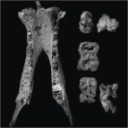
A new species of hippopotamine (Cetartiodactyla, Hippopotamidae) from the late Miocene Baynunah Formation, Abu Dhabi, United Arab EmiratesJean-Renaud Boisserie
Published online: 07/04/2017 |
S.I. Data |

|
La poche à phosphate de Ste-Néboule (Lot) et sa faune de vertebres du Ludien supérieur. 12- Fissipèdes (Carnivores)Louis de Bonis
Published online: 25/09/1978 |
|

|
Pronycticebus neglectus - an almost complete adapid primate specimen from the Geiseltal (GDR)Urs Thalmann, Hartmut Haubold and Robert D. MartinPublished online: 04/12/1989Keywords: Adapiformes; Eocene; Paleoecology; PHYLOGENY; Pronycticebus neglectus https://doi.org/10.18563/pv.19.3.115-130 Abstract In the course of the current revision of adapid primates from the Eocene Geiseltal, an almost complete specimen was found in the Geiseltal Museum collections. The fossil, the most complete adapid specimen so far discovered in Europe, has been determined as Pronycticebus neglectus n. sp. PV article infos Published in Vol. 19, Fasc. 3 (1989) |
|

|
Reflections on some Russian eotheriodonts (Reptilia, Synapsida, Therapsida)Denise Sigogneau-Russell and P. K. TchudinovPublished online: 28/02/1972Keywords: Reptilia; Russia; Synapsida; Therapsida https://doi.org/10.18563/pv.5.3.79-109 Abstract As a result of the enrichment of eotheriodont material by one of us (P.K.T.), these specimens (essentially Biarmosuchur and Eotitanosuchur) are reexamined and refigured. A reevaluation of their particularities supports the distinction of two families, for which new diagnoses are proposed. This leads us to discuss the affinities of these families, with respect to the sphenacodonts on one hand, and to the South African primitive theriodonts on the other (gorgonopsids and ictidorhinids). This study contains inherent paleogeographic consequences which are considered in conclusion. PV article infos Published in Vol. 05, Fasc. 3 (1972) |
|

|
The skull of Arsinoitherium (Mammalia, Embrithopoda) and the higher order interrelationships of ungulatesNicholas CourtPublished online: 17/12/1992Keywords: Arsinoitherium; PHYLOGENY; Skull; Ungulate https://doi.org/10.18563/pv.22.1.1-43 Abstract Detailed anatomical description of arsinoithere cranial remains from the Lower Oligocene, Fayum Depression, Egypt, provides the basic data for a systematic investigation. All cranial and some postcranial features are assessed from a phylogenetic standpoint. Several soft tissue characters are then added to a cladistic analysis based on 54 derived ungulate morphological characters. The resulting phylogenetic hypothesis implies that perissodactyls, sirenians, proboscideans and arsinoitheres constitute a monophyletic unit (5 synapomorphies). However, increasing the tree length by 3 steps reveals a closer association between hyraxes and perissodactyls. Nevertheless, 13 synapomorphies link proboscideans, sirenians and arsinoitheres to the exclusion of all other ungulates. Form of the sphenopalatine and ethmoid foramina, recurved posttympanic process, absence of a fenestra rotundum in the petrosal, vestigial paroccipital process of the exoccipital and the highly unusual absence of a hypoglossal foramen in the skull, imply a robust sister-group relationship between arsinoitheres and proboscideans. In this analysis artiodactyls share only one derived character with all other ungulates studied. Monophyly of Ungulata, including Artiodactyla, is therefore only weakly supported. It is argued that pedal anatomy of hyraxes is non-homologous with that of Tethytheria. Arsinoitherium should now be classified within Tethytheria, sharing a sister-group relationship with Proboscidea. Hyraxes are excluded, thus refuting the concept of Paenungulata. However, monophyly of the wider concept, Pantomesaxonia, containing hyraxes, perissodactyls, sirenians, proboscideans and now, arsinoitheres, is supported by this study. PV article infos Published in Vol. 22, Fasc. 1 (1992) |
|
