|
FIRST OCCURRENCE OF PAMPATHERIUM (XENARTHA: PAMPATHERIIDAE) FROM THE EL CEDAZO CREEK, AGUASCALIENTES, MEXICO
Published online: 01/01/1970
Keywords:
Aguascalientes; El Cedazo; Mexico; Pampatherium; Pleistocene
https://doi.org/10.18563/pv.49.2.e3
Abstract
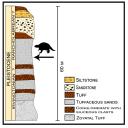
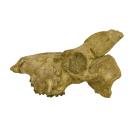
The glyptodontid Pampatherium is currently known from Pleistocene and Pliocene deposits in the State of Mexico, Puebla, Jalisco and Guanajuato. Recently, from the Late Pleistocene locality of El Cedazo creek (Aguascalientes), has revealed fragmentary remains assigned by its anatomical characteristics to the genus Pampatherium. The recovered specimen consists of an articulated anterior left fragment of the carapace comprising 78 osteoderms, which display the diagnostic ornamentation of the genus including a depressed central area, attenuated ornamentation, reduced or absent marginal band, as well as a general rectangular shape. These morphological characteristics clearly support assignment to the genus Pampatherium and distinguish the material from Holmesina, which has been previously reported from the El Cedazo Local Fauna. However, the absence of cranial or dental material and the potential influence of ontogenetic variation preclude a confident species-level identification. Accordingly, the specimen is referred to Pampatherium sp. This finding represents the first confirmed record of the genus in the state of Aguascalientes and provides new evidence of the presence of pampatheriids in the El Cedazo Local Fauna.
PV article infos
Article state: in_press
|
PDF
|
|
Miocene Bovidae (Mammalia) of the Siwaliks Part 2: Antilopinae
Published online: 01/01/1970
Keywords:
Bovidae; Miocene; Siwaliks; horn cores
https://doi.org/10.18563/pv.49.2.e1
Abstract
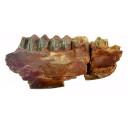
The fluvial sediments of the Siwaliks in northern Pakistan contain a geologic and paleontological record encompassing the Miocene and Pliocene. The sediments, which are thousands of meters thick, have abundant vertebrate and invertebrate fossils from multiple horizons. Fossils were initially discovered in the Siwalik Hills of India in 1832 and there are collections of Siwalik fossils not only in the Museum of the Geological Survey of India, but also in various European, British, and American museums. Renewed collecting in northern Pakistan in collaboration with the Geological Survey of Pakistan has now added over 10,000 bovid fossils to a new collection in Islamabad. The fossils include many isolated horn cores and occasional skulls, as well as teeth and postcranials. Here we discuss material belonging to the Antilopinae, recognizing fifteen species belonging to at least three tribes. Five of the fifteen have previously been named, while an additional two have cranial material suitable for defining a new species. The remaining eight are known from cranial material that allows us to distinguish them from other Siwalik bovids, but in most instances they are of doubtful generic identity and we think may belong to previously recognized taxa from other geographic regions. One (?Protragelaphus sp.) probably belongs to an unnamed species, but because the available material is inadequate for defining a new species, we do not name it at this time. The Antilopini predominate in the fossil collections, both in terms of number of species and number of specimens.
PV article infos
Article state: in_press
|
PDF
S.I. Data
|
|
Pterosaurs (Pterosauria) from the Cerro del Pueblo Formation (Late Campanian) of Coahuila, Mexico
Published online: 21/11/2025
Keywords:
Azhdarchoidea; Coahuila; Mexico; Pterodactyloidea; Pterosauria
https://doi.org/10.18563/pv.48.2.e1
Abstract
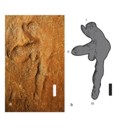
The Late Campanian Cerro del Pueblo Formation, located in southeastern Coahuila, Mexico, has produced a diverse array of vertebrate fossils. However, pterosaur remains from this unit are notably scarce. In this study, we describe new pterosaur material from the formation. The specimens include a fragmentary vertebra identified as belonging to an indeterminate, but derived pterodactyloid, along with the distal condyle of a left metacarpal, referable to an azhdarchoid pterosaur, and a left manus print. While these specimens provide additional evidence of pterosaur presence in the region during the Late Cretaceous, their fragmentary nature limits precise taxonomic and ichnotaxonomic identification. Nevertheless, they highlight the potential for future discoveries that could refine our understanding of the diversity and distribution of pterosaurs in Mexico.
PV article infos
Published in 48-2 (2025)
|
PDF
|
|
Miocene Bovidae (Mammalia) of the Siwaliks, Part 1: Hypsodontinae and Bovinae.
Published online: 30/07/2026
Keywords:
Bovidae; horncores; Miocene; Siwaliks
https://doi.org/10.18563/pv.49.1.e1
Abstract
The fluvial sediments of the Siwaliks in northern Pakistan preserve an exceptional geologic and paleontological record encompassing parts of the Oligocene and all of the Miocene and Pliocene. The sediments, which can be thousands of meters thick, have abundant vertebrate and invertebrate fossils from hundreds of different levels. Fossils were first discovered in the Siwaliks in 1832 and there are important collections of them in the Museum of the Geological Survey of India as well as in various European, British, and American museums. Renewed collecting has now added over 10,000 bovid fossils to a new collection held by the Geological Survey of Pakistan. The fossils include rare skulls and many isolated horn cores, as well as teeth and postcranials. Here we discuss material belonging to the hypsodontinae, boselaphini, and bovini. We recognize four hypsodontine and twenty-two bovine species, plus one species of uncertain subfamilial placement. Nineteen of the twenty-seven have previously been named, while another five have cranial material suitable for defining a new species. Two species, referred to as ?Hypsodontinae sp. and Bovidae sp. 1, are distinctive but left unnamed. We are also uncertain about how distinctive what we refer to as Selenoportax aff. vexillarius is from Selenoportax vexillarius. Boselaphinines predominate in the fossil collections, both in terms of number of species and number of specimens. Most of the boselaphine genera are endemic to the Siwaliks, as are the hypsodontine Palaeohypsodontus and the possible bovini Pachyportax. The predominance of boselaphines together with the number of endemic taxa gives the Siwalik bovid fauna a distinctive aspect and collectively comprise the best-known Miocene record of the subfamily.
PV article infos
Article state: in_press
|
PDF
S.I. Data
|
|
Abstract book of the 18th Conference of the European Association of Vertebrate Palaeontologists (EAVP), 5-9 July 2021, Benevento, Italy
Published online: 12/07/2021
Keywords:
2021; Abstracts; Benevento; EAVP
https://doi.org/10.18563/pv.eavp2021
Abstract
Welcome to the 18th conference of the EAVP, the first online meeting of our association. The pandemic emergency made it impossible to organize the in-person meeting in Benevento as we all had hoped. However, we couldn’t miss another EAVP meeting. Therefore, this year we are meeting online, trying to make the experience the closest to the in-person meeting possible, in order to offer the delegates the opportunity to share knowledge, build new networks and reinforce the old ones. We have received 137 communications, with more than 150 delegates from 24 countries. All the abstracts have passed a peer review process and are part of this special volume of Palaeovertebrata, the official journal of the EAVP. This year we are also offering a variety of workshops, roundtables and symposia on different topics. These include the annual “Pride EAVP: An LGBTQ+ Roundtable” and “Women in Palaeontology Roundtable Discussion”, together with the workshops on “Gendered Perspective in Palaeontological Research: from Definition to Action”, “International Palaeontology Education: Virtual Teaching and Real-World Learning”, “Stepping out of Academia: Why, When and How?”, “Introduction to Hypothesis Testing in Statistics”, “The Early-Middle Pleistocene Transition: Marked Mammal Turnover and Ecosystem Dynamic” (included in the early event for the XXI INQUA Congress in Rome 2023, “A Mediterranean Perspective on Quaternary Sciences”). To conclude, we are hosting two symposia on “Palaeoart: Diversity on and behind the Canvas” and “3D fossils, Robotic and Experimental Palaeontology”. We wish you all a happy and productive meeting. And see you in Benevento next year!
PV article infos
Published in Special Volume 1-2021 (2021)
|
PDF
|

|
Study of the Turolian hipparions of the lower Axios valley (Macedonia, Greece). 4. Localities of Dytiko.
Published online: 15/12/1988
Keywords:
Equidae; Greece; Hipparion; Lower Axios Valley; Macedonia; Mammalia; Turolian
https://doi.org/10.18563/pv.18.4.187-239
Abstract
The hipparions from the Dytiko localities of the lower Axios valley (Macedonia, Greece) are studied. The material comes from three localities Dytiko-l, 2, 3 (DTK, DIT, DKO), which are situated near the village of Dytiko, about 60 km northwest to Thessaloniki. Three species have been determined, the medium-sized H. mediterraneum, the small-sized H. matthewi and the very small-sized H. periafricanum. The determined Hipparion species, their morphological characters and their comparison with the other Axios valley material indicate a Late Turolian age for the Dytiko localities.
PV article infos
Published in Vol. 18, Fasc. 4 (1988)
|
PDF
|
|
L’assemblage mammalien de l’Eocène continental du Complexe de Gour Lazib (Algérie) : structure écologique et implications paléoenvironnementales
Published online: 01/01/1970
Keywords:
Afrique du Nord; Cénogramme; Paléogène; Vertébrés
https://doi.org/10.18563/pv.49.2.e2
Abstract
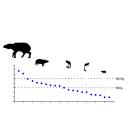
Des prospections géologiques et paléontologiques sur les affleurements continentaux paléogènes du Complexe de Gour Lazib (Hammada du Dra, Algérie) nous ont permis de mettre en évidence plusieurs sites à vertébrés, sur une superficie de plus de cinq cents kilomètres carrés. La faune est constituée de nombreux vertébrés fossiles associant mammifères placentaires, poissons actinoptérygiens et protoptères, squamates, amphibiens, chéloniens, crocodiles et oiseaux. La flore de charophytes est également diversifiée. Les données bio-magnétostratigraphiques indiquent un âge compris entre l’Yprésien terminal et le Lutétien basal pour cet assemblage unique en Afrique. Les nombreux restes de mammifères récoltés ont une préservation exceptionnelle pour le Paléogène ancien arabo-africain et permettent une reconstitution paléoenvironnementale réalisée via une méthode couplant cénogramme et distribution pondérale des taxons arboricoles. Le profil du cénogramme, caractérisé par l’abondance des espèces de petite taille (insectivores, primates et rongeurs), la présence d’espèces de taille intermédiaire (hyracoïdes) et la rareté des grandes espèces (uniquement représentées par les hyracoïdes ; absence notable des proboscidiens et embrithopodes), met en évidence un milieu forestier assez fermé sous climat tropical. Par ailleurs, les données lithologiques et sédimentologiques indiquent un milieu fluviatile méandriforme où ont proliféré les charophytes. Plus hypothétique reste l’existence d’une saisonnalité dans les Gour Lazib, avec de possibles périodes temporaires modérément arides.
PV article infos
Article state: in_press
|
PDF
S.I. Data
|

|
Un Haplobunodontidae nouveau Hallebune krumbegeli nov.gen. nov.sp. (Artiodactyla, Mammalia) dans l'Eocène moyen du Geiseltal près Halle (Sachsen-Anhalt, Allemagne)
Published online: 14/06/1995
Keywords:
Artiodactyla; Geiseltal; Germany; Mammal; Middle Eocene; new gen.; new sp.
https://doi.org/10.18563/pv.24.1-2.85-99
Abstract
A new genus and species of haplobunodontid artiodactyl, Hallebune krumbiegeli nov. gen. nov. sp., is described from the middle Eocene Geiseltal Fauna (Saxon-Anhalt, Germany). Its stratigraphic range is restricted to the MP 13 ("obere Mittelkohle") of the Geiseltalian. The material consists of seven fragments, representing both upper and lower jaws. It is indicated, that H. krumbiegeli was a small bunodont herbivore. The size and primitive character of the teeth suggest that the genus possibly is directly derived from Diacodexeidae.The new material forms the basis for reinterpreting the haplobunodontid phylogeny.
PV article infos
Published in Vol. 24, Fasc. 1-2 (1995)
|
PDF
|

|
Une nouvelle espèce de Steneosaurus (Thalattosuchia, Teleosauridae) dans le Callovien du Poitou (France) et la systématique des Steneosaurus longirostres du Jurassique moyen d'Europe Occidentale.
Published online: 15/09/1998
Keywords:
middle Jurassic; nov. sp.; phylogenetic relationships; skulls; Steneosaurus pictaviensis; Systematics; thalattosuchian crocodile
https://doi.org/10.18563/pv.27.1-2.19-44
Abstract
The study of all the available skulls allows us to review the systematic relationships of the longirostrine Steneosaurus from the Middle Jurassic of western Europe. Up to now, Aalenian and Bajocian deposits have not yielded any significant Steneosaurus remain. In the Bathonian, the only valid longirostrine species, S. megistorhynchus, is known in the Britain-Normandy Basin, the Poitou and the Lorraine. In the Callovian, most of the longirostrine Steneosaurus remains can be attributed to the species S. leedsi. Nevertheless, some remains from the Middle Callovian of Poitou (France) show important differences with S. leedsi. A new Steneosaurus species, only known in Poitou, is created and named S. pictaviensis. The specific characters are carried by the skull (preorbital pit well marked, orbit and ptetygoid fossae shapes), by the mandible (symphysis shape) and by the teeth (ornamentation). S. megistorhynchus is probably situated near the stem of the Callovian species but remains from the Bathonian and Lower Callovian are very scarce and it is very difficult to precise the phylogenetic relationships between the longirostrine species of the Middle Jurassic.
PV article infos
Published in Vol. 27, Fasc. 1-2 (1998)
|
PDF
|

|
Otolithes de poissons du Pliocène inférieur de Papiol, près de Barcelone.
Published online: 15/09/1998
Keywords:
Catalonia; otoliths; Pliocene; Spain; teleosts
https://doi.org/10.18563/pv.27.1-2.1-17
Abstract
The Zanclian marls from Papiol provided otoliths belonging to 53 teleost taxa; nine of those are new for the Mediterranean Pliocene. The association reflects a bathymetry between 150 and 350 m, but it is likely that such depths only existed at the initial stage of flooding of the Llobregat bay. A compilation of the available data for the whole Mediterranean realm at Zanclian time provided a list of 163 taxa, of which 105 could be identified at species level. This last group provides the most useful data for evaluating the composition and affinities of the Mediterranean Zanclian fauna, which appears to be significantly different from the Recent Mediterranean fauna. The Zanclian fauna counts 68 % of Recent species: 12,5 % were already represented in the Mediterranean Miocene, 37 % appeared there at the Zanclian, and 18 % are extra-Mediterranean today. This last group is essentially composed by oceanic fishes, living in the warm parts of the Atlantic and Indo-Pacific Oceans. It is evident that a non neglectable number of Recent species only penetrated very recently in the Mediterranean, which stresses the differences between the more oceanic Zanclian Mediterranean fauna and the present one.
PV article infos
Published in Vol. 27, Fasc. 1-2 (1998)
|
PDF
|

|
The late Miocene percrocutas (Carnivora,Mammalia) of Madedonia, Greece.
Published online: 14/06/1995
Keywords:
Biochronology; Carnivora; Comparisons; Dinocrocuta; Greece; Late Miocene; Mammalia
https://doi.org/10.18563/pv.24.1-2.67-84
Abstract
Some new material of percrocutas from the late Miocene of Axios valley (Macedonia, Greece) is studied. They have been found in the locality of "Pentalophos 1" (PNT). The material has been described and compared with the known late Miocene percrocutas of Eurasia. This comparison indicates that it can be identified as Dinocrocuta gigantea (SCHLOSSER, 1903). A maxilla of a percrocuta, named ”Hyaena" salonicae, was found in the same area (Andrews, 1918). "Hyaena" salonicae is smaller than the PNT material. It is also compared with other material from Eurasia while its taxonomic and age problems are discussed. It belongs to Dinocrocuta and shows close relationships with D. robusta and D. senyureki; its age can be considered as late Vallesian-early Turolian. The age of the locality PNT is also discussed and a possible Vallesian age is proposed for it.
PV article infos
Published in Vol. 24, Fasc. 1-2 (1995)
|
PDF
|

|
Reflections on some Russian eotheriodonts (Reptilia, Synapsida, Therapsida)
Published online: 28/02/1972
Keywords:
Reptilia; Russia; Synapsida; Therapsida
https://doi.org/10.18563/pv.5.3.79-109
Abstract
As a result of the enrichment of eotheriodont material by one of us (P.K.T.), these specimens (essentially Biarmosuchur and Eotitanosuchur) are reexamined and refigured. A reevaluation of their particularities supports the distinction of two families, for which new diagnoses are proposed. This leads us to discuss the affinities of these families, with respect to the sphenacodonts on one hand, and to the South African primitive theriodonts on the other (gorgonopsids and ictidorhinids). This study contains inherent paleogeographic consequences which are considered in conclusion.
PV article infos
Published in Vol. 05, Fasc. 3 (1972)
|
PDF
|
|
Preliminary report on the fishes (Chondrichthyes & Teleostei) from the lower Oligocene (Rupelian) Red Bluff Clay at site AMo-9, Monroe County, Alabama, USA
Published online: 26/06/2024
Keywords:
Batomorphii; Elasmobranchii; Galeomorphi; Gulf Coastal Plain; Vicksburg Group
https://doi.org/10.18563/pv.47.2.e2
Abstract
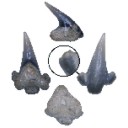
Herein we describe a small but relatively diverse assemblage of fossil fishes derived from the lower Oligocene (Rupelian) Red Bluff Clay at site AMo-9 in Monroe County, Alabama, USA. Identified amongst the remains are 15 unequivocal taxa representing 11 families within five orders, and one additional taxon represents an unknown order and family. Taxa identified include Eostegostoma sp., Otodus (Carcharocles) sp., Mitsukurinidae/Carchariidae indet., Macrorhizodus praecursor, Galeorhinus sp., Negaprion gilmorei, Physogaleus sp., “Sphyrna” sp., Galeocerdo sp., cf. “Aetobatus” sp., Sphyraena sp., Xiphiorhynchus kimblalocki, Xiphiorhynchus sp., Cylindracanthus ornatus, and C. rectus. Several additional fossils could not be identified beyond Lamniformes, Carcharhiniformes, and Teleostei, but they likely belong to one of the identified taxa within this paleofauna. All of the fishes previously reported from the Red Bluff Clay within the entirety of the Gulf Coastal Plain of the USA are otolith-based, and each of the 15 unequivocal taxa reported herein are important new records for this lithostratigraphic unit. In particular, the Eostegostoma sp. and Xiphiorhynchus spp. specimens represent the first occurrences of these taxa in Alabama. The specimens of C. ornatus, Eostegostoma sp., and X. kimblalocki are stratigraphic and temporal range extensions from the middle and late Eocene into the Rupelian Stage of the Oligocene. Other described taxa may represent transitional forms between those described from the late Eocene and late Oligocene within the region. This study provides a tantalizing preliminary view into faunal transitions that occurred amongst marine fishes across the Eocene/Oligocene boundary within the Gulf Coastal Plain of the USA.
PV article infos
Published in 47-2 (2024)
|
PDF
|

|
Diversity among north african dinosaur eggshells.
Published online: 15/12/2003
Keywords:
Cretaceous; Dinosaurs diversity; Eggshells; Maastrichtian; Morocco; North Africa; taxonomy
https://doi.org/10.18563/pv.32.2-4.171-188
Abstract
Until the discovery of dinosaur eggshells locality in the Oukdiksou syncline, (Middle Atlas, Morocco) in 1999 (Garcia et al. this volume) the maastrichtian reptiles faunas were unknown in North Africa. Additional material from Achlouj-2 allows us to describe five oospecies, belonging to four oofamilies. The Megaloolithidae is recorded by Megaloolithus maghrebiellsis Garcia el al. and Pseudomegaloolithus atlasi oogen. novo oospec. nov. Tipoolithus achloujensis Garcia et al. is questionably considered as a Subtiliolithidae. A relatively small Elongatoloolithidae is represented by Rodolphoolithus arioul oogen. nov. oospec. nov. A thin Prismatoolithidae is described as a new oospecies of ? Pseudogeckoolithus Vianey-Liaud & Lopez-Martinez, 1997: P. tirboulensis. The diversity of these oospecies indicates that the dinosaur fauna comprises at least five dinosaur oospecies, with perhaps one sauropod and three theropods.
PV article infos
Published in Vol. 32, Fasc. 2-4 (2003)
|
PDF
|

|
Fossil snakes from the Palaeocene of Sao José de Itaborai, Brazil, Part II. Boidae
Published online: 28/12/2001
Keywords:
Boidae; Boinae; Brazil; Erycinae; New taxa; Palaeocene; Snakes
https://doi.org/10.18563/pv.30.3-4.111.150
Abstract
The middle Palaeocene of São José de ltaboraí (State of Rio de Janeiro, Brazil) has produced a rich and diverse fauna of boid snakes. It comprises six or seven species: Hechtophis austrinus gen. et sp. nov., Corallus priscus sp. nov., Waincophís pressulus sp. nov., Waincophis cameratus sp. nov.,"Boinae A", and "Boinae B". Moreover, two dentaries might pertain to either H. austrinus or "Boinae B", or even represent a distinct taxon. Hechtophis austrinus is assigned, with reservation, to the Erycinae. All other taxa are referred to the Boinae. The vertebrae of all taxa have paracotylar foramina, which raises the problem of the apomorphic or plesiomorphic nature of this feature. This fauna also raises the question of the presence of extinct erycine boids in South America, but it does not allow this question to be settled.
PV article infos
Published in Vol. 30, Fasc. 3-4 (2001)
|
PDF
|
|
Rodent paleocommunities from the Oligocene of Ulantatal (Inner Mongolia, China)
Published online: 10/06/2014
Keywords:
late Paleogene; Mammalia; Mongolian Plateau; Rodentia; Systematics
https://doi.org/10.18563/pv.38.1.e3
Abstract
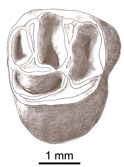
The Oligocene deposits of the Ulantatal area in Inner Mongolia (China) contain among the richest mammalian faunas from Asia. To date, only some parts of the rodent faunas have been described. Here, we propose to review the rodent faunal lists for each site, including the description of a few new rodent specimens. We describe three additional rodent species: the Cylindrodontidae Anomoemys lohiculus, the Eomyidae Asianeomys sp., and the Dipodidae Litodonomys huangheensis. This study allows us to constrain the stratigraphic range of Anomoemys lohiculus, which ranged from the late Early Oligocene to the early Late Oligocene in this area. Asianeomys sp. and Litodonomys huangheensis are dated from the latest Oligocene. These Oligocene deposits consist now of more than 70 species of mammals if we include the fauna from Kekeamu. This latter corresponds to the basal part of the Ulantatal Formation and could be dated biochronologically from the earliest Oligocene. When compared to the faunas from the Valley of Lakes in Central Mongolia, the Ulantatal faunas present a great majority of rodents, and this difference can be partly explained by sampling and description biases regarding macro-mammals. This study also shows that variations existed between Inner and Central Mongolia, especially regarding the composition of the rodent paleocommunities. However, the assessment of their evolutionary history in this part of Asia with respect to the important climate and environment changes, require further precisions and more material than current data allow.
PV article infos
Published in Vol.38-1 (2014)
|
PDF
|

|
Les artiodactyles du gisement yprésien terminal de Premontre (Aisne, France)
Published online: 16/12/1996
Keywords:
Artiodactyls; France; Mammals; new species; Ypresian
https://doi.org/10.18563/pv.25.2-4.391-414
Abstract
The artiodactyls (Mammalia) from the latest Ypresian locality of Prémontré from the Paris Basin (niveau repère MP 10 in the lower Eocene of the Paris Basin) are described in this paper. Three species have been identified: 1) Diacodexis cf. varleti SUDRE et al., 1983; 2) a new species of Eurodexis ERFURT & SUDRE (E. russelli nov. sp.) defined after the revision of the species Messelobunodon? ceciliensis from the Lutetian beds of Geiseltal (Germany); and 3) Eurodexeinae indet., a probable ancestor of another form from the Geiseltal which was previously recorded as Homacodon? sp. (Erfurt 1993) and now named Parahexacodus germanicus. The two later forms are referred to the new subfamily Eurodexeinae (Erfurt & Sudre 1996). The analysis of these forms as weIl as comparative studies have led us to reconsider our previous conclusions regarding the content of the species Protodichobune oweni LEMOINE 1878 and some aspects of Ypresian diacodexid evolution. One can postulate that the divergence of E. russelli nov. sp. occurred during the first radiation of these primitive artiodactyls. Some other stem form with bunodont teeth such as Protodichobune and Aumelasia have also differentiated from Diacodexis. Like Eurodexis, these two genera persist during the middle Eocene. The absence of Protodichobune and Aumelasia at Prémontré is probably due to particular ecological conditions.
PV article infos
Published in Vol. 25, Fasc. 2-4 (1996)
|
PDF
|
|
Enigmatic rodents from Lavergne, a late middle Eocene (MP 16) fissure-filling of the Quercy Phosphorites (Southwest France)
Published online: 08/04/2024
Keywords:
diversity; late Bartonian; Rodentia; taxonomy; Theridomyidae
https://doi.org/10.18563/pv.47.2.e1
Abstract
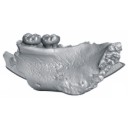
Two somewhat “odd” taxa of theridomyid rodents, one formerly known (Bernardia marandati Vianey-Liaud, 1991) and the other new (Idicia vidalenci gen. et sp. nov.) are discussed from a taxonomical and taphonomical perspectives. These two rodents were found at Lavergne, a late middle Eocene (MP16) “phosphatière” from the Quercy (Southwest France). The genus Bernardia, being preoccupied by a scale insect (Bernardia Ashmead, 1881), is here renamed Burgia. We benefit from this nomenclatural change to describe additional new dental specimens of this patriotheridomyine species, including a previously undescribed locus (P4). The other theridomyid from Lavergne, Idicia vidalenci gen. et sp. nov., so far documented by a mandible preserving two teeth (m2-m3) is a new taxon of peculiar occlusal morphology, and whose subfamilial affinities remain unknown. These two peculiar theridomyids recorded at Lavergne are found nowhere else, whether in coeval localities in Quercy or elsewhere in Western Europe. We discuss the possible causes of their unique presence at Lavergne.
PV article infos
Published in 47-2 (2024)
|
PDF
|

|
Contribution à l'étude des Cricétidés oligocènes d'Europe occidentale
Published online: 20/01/1972
Keywords:
Cricetidae; Europe; Oligocene
https://doi.org/10.18563/pv.5.1.1-44
Abstract
Of the ten cricetid species from the Oligocene of Western Europe, attributed until now to the genus Eucricetodon, only four prove to be utilizable - E. atavus, E. huberi, E. praecursor, E. collatum - to which it is possible to add two forms newly described: E. huerzeleri and E. quercyi. The evolullon of the genus Pseudocricetodon is also the subject of new observations. The study of the dental morphology allows us to distinguish in these two genera three lineages beginning in the middle Oligocene:
- Lineage P. montalbenensis-P. thaleri (from Montalban to Goderet), of small size, without
increase in size.
- LineageE. atavus-E. infralactorensis (from Hoogbulsel to Estrepouy), of middle size, with a regular increase in size.
- Lineage E. huerzeleri-E. haslachense (level of Montalban to that of Estrepouy), of large size, with an increase in size.
Two other forms are equally represented in these loealitles: Heterocricetodon aff. helbengi and Melissiodon quercyi. It has been possible to attribute a precise age (zone of "Cournon") to the last species, which has been defined by Schaub (l925) from material in the Old Quercy collections. The genera Pseudocricetodon, Eucricetodon, ? "Cricetodon", Leydimys, Eumys, differentiated at the beginning of the middle Oligocene in Europe, Asia and North America, seem to derive from a common ancestral group. The place of origin of this group could be situated in Asia.
PV article infos
Published in Vol. 05, Fasc. 1 (1972)
|
PDF
|

|
A New caseid Synapsid from the Permian (Guadalupian) of the Lodève basin (Occitanie, France)
Published online: 18/07/2022
Keywords:
; Caseidae; France; Guadalupian; semi-aquatic lifestyle
https://doi.org/10.18563/pv.45.2.e2
Abstract
Lalieudorhynchus gandi gen. nov. and sp. nov. is a new caseid synapsid from the Permian of the Lodève Basin, Occitanie, France. This new taxon is represented by a partial but well-preserved postcranial skeleton, and is characterized by the following apomorphies: a transverse section of the sacral and anterior caudal neural spines with a very thin keel-like process anteriorly, a slender dorsal tip of the dorsal and caudal spines, a narrow distal end of the first sacral rib, a fossa on triceps process of metacoracoid, and a very large distal tarsal 1 of same width than the astragalus, with nearly all sides being shallowly concave.
The skeleton corresponds to a sub-adult individual that was excavated from the La Lieude Formation dated as Roadian-Capitanian (Guadalupian). A sedimentological and taphonomical analysis of the type locality, together with preliminary osteohistological observations, suggest that this new French caseid was rather aquatic, as already hypothesised for other large forms.
A phylogenetic analysis of caseids is performed to test the position of this new taxon and to better understand the evolution of the clade: interestingly, Lalieudorhynchus gandi gen. nov. et sp. nov. is closer to the NorthAmerican “Cotylorhynchus” hancocki than to the other French caseids Ruthenosaurus and Euromycter from the Artinskian of the geographically closer Rodez Basin. These two last caseids document the Artinskian radiation of the clade, which remained diverse until Olson’s extinction. Caseids survived, as Lalieudorhynchus is one of the youngest representatives of the clade, and may have used novel ecological strategies to access their vegetarian food sources.
PV article infos
Published in 45-2 (2022)
|
PDF
|