|
Revision of the historical collections of Pliocene-Pleistocene large mammals from Le Riège and Saint-Palais localities, near Pézenas (Southern France)
Published online: 23/06/2025
Keywords:
Hérault; Mammalia; Montpellier; Neogene; Quaternary
https://doi.org/10.18563/pv.48.1.e2
Abstract
Numerous “Quaternary” large-mammal fossils have been collected since the 1830s along the Le Riège stream, near Pézenas (Southern France). More than 120 specimens are stored in the collections of the Université de Montpellier (UM) under the name “Le Riège”. A major operation aiming at relocating the palaeontological collections of the University has made it possible to group together all the specimens of interest and launch their systematic revision for the first time. The fossils belong to the Reboul (1839; 51 samples) and de Christol (1865; 18 samples) Collections and 17 samples compose the Crochet & Ivorra Collection (1998). The remaining 38 samples have no mention about the exact time and location of their finding. We provide a critical inventory with literal transcription of inscriptions on specimens and historical labels. This revision confirms the presence of two distinct faunal assemblages under the name of “Le Riège”: Saint-Palais (Early Pliocene, MN14–15) and Le Riège sensu stricto (late Early Pleistocene, most likely MNQ19). The former assemblage, with coastal affinities, is composed of the ruminants Alephis sp. and Procapreolus cf. pyrenaicus, the rhinocerotid Pliorhinus megarhinus, the gomphotheriid Anancus arvernensis and marine mammals, all emblematic taxa for the Early Pliocene of Montpellier and Perpignan. The latter assemblage documents a late Early Pleistocene fluvio-volcanic sequence, yielding the bovid Bison (Eobison) spp., the cervid Eucladoceros cf. giulii, the hippopotamid Hippopotamus antiquus, the rhinocerotid Stephanorhinus etruscus, the equid Equus cf. altidens, and the elephantid Mammuthus cf. meridionalis, plus a few specimens of uncertain taxonomic affinities. This revision underscores the interest of revisiting historical collections and further provides a starting point for future research.
PV article infos
Published in 48-1 (2025)
|
PDF
S.I. Data
|
|
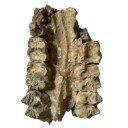
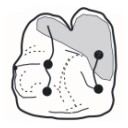
A late Eocene palaeoamasiine embrithopod (Mammalia, Afrotheria) from the Adriatic realm (Island of Rab, Croatia)
Published online: 14/12/2023
Keywords:
Balkanatolia; Grande Coupure; Great Adria; Paleobiogeography; Systematics
https://doi.org/10.18563/pv.47.1.e1
Abstract
A cheek tooth recently unearthed in the Lopar Sandstone unit, of late Eocene age, in the northern part of Rab Island, Croatia, is one of the very few Eocene mammalian remains found in the Adriatic area. Thorough comparison of this tooth with those of Old-World Palaeogene mammalian orders suggests that it is a M3 belonging to an embrithopod afrothere. The specimen is referred to as Palaeoamasia sp. This genus was formerly known only in Eocene deposits of Anatolia but with close relatives in Romania among Palaeoamasiinae. The geographical distribution of this subfamily perfectly matches the recently-named Balkanatolian landmass, which experienced in-situ evolution of endemic mammals prior to the Grande Coupure event that occurred around the Eocene–Oligocene transition. This last event is characterised by massive Asian immigration in Western Europe and the supposed extinction of many endemic Central and Western European mammals, including Palaeoamasiinae.
PV article infos
Published in 47-1 (2024)
|
PDF
|
|
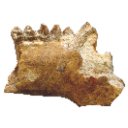
The new Algerian locality of Bir el Ater 3: validity of Libycosaurus algeriensis (Mammalia, Hippopotamoidea) and the age of the Nementcha Formation
Published online: 10/06/2015
Keywords:
Dispersal event; Miocene; North Africa; Tetralophodon
https://doi.org/10.18563/pv.39.2.e1
Abstract
The description of original material of anthracothere and proboscidean in the new locality of Bir el Ater 3 from East Algeria, and a thorough review of early Libycosaurus remains of Bir el Ater 2 allows us validating L. algeriensis as the smallest and earliest species of Libycosaurus and probably the earliest migrant of the genus from Asia. The presence of a Tetralophodon in the Neogene Nementcha formation might represent the earliest occurrence of the genus in Africa. These original fossil remains allow us to discuss the age of the Neogene part of the Nementcha formation close to the Serravalian/Tortonian boundary.
PV article infos
Published in Vol.39-2 (2015)
|
PDF
|
|
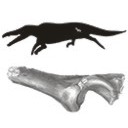
First record of the family Protocetidae in the Lutetian of Senegal (West Africa)
Published online: 05/12/2014
Keywords:
innominate; Lutetian; Protocetid; Senegal
https://doi.org/10.18563/pv.38.2.e2
Abstract
The earliest cetaceans are found in the early Eocene of Indo-Pakistan. By the late middle to late Eocene, the group colonized most oceans of the planet. This late Eocene worldwide distribution clearly indicates that their dispersal took place during the middle Eocene (Lutetian). We report here the first discovery of a protocetid fossil from middle Eocene deposits of Senegal (West Africa). The Lutetian cetacean specimen from Senegal is a partial left innominate. Its overall form and proportions, particularly the well-formed lunate surface with a deep and narrow acetabular notch, and the complete absence of pachyostosis and osteosclerosis, mark it as a probable middle Eocene protocetid cetacean. Its size corresponds to the newly described Togocetus traversei from the Lutetian deposits of Togo. However, no innominate is known for the Togolese protocetid, which precludes any direct comparison between the two West African sites. The Senegalese innominate documents a new early occurrence of this marine group in West Africa and supports an early dispersal of these aquatic mammals by the middle Eocene.
PV article infos
Published in Vol.38-2 (2014)
|
PDF
|