
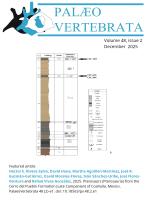
Abstract book of the 18th Conference of the EAVP
Pterosaurs from Coahuila
Miocene Bovidae (Mammalia) of the Siwaliks: Hypsodontinae and Bovinae
Les sélaciens du Miocène de la région de Montpellier
Contribution à l'étude des genres Gliravus et Microparamys.
Muridae du Pliocène supérieur d'Espagne et du midi de la France.
Eocene (57) , Quercy Phosphorites (38) , Systematics (32) , Rodents (29) , Mammalia (27) , Rodentia (25) , Miocene (25)
Page 10 of 19, showing 20 record(s) out of 367 total
|
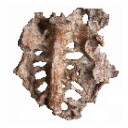
New remains of the giant bird Gargantuavis philoinos from the Late Cretaceous of Provence (south-eastern France)Eric Buffetaut
Published online: 27/08/2015 |
|

|
Recherches de mammifères paléogènes dans les départements de l'Aisne et de la Marne pendant la deuxième moitié du vingtième sièclePierre LouisPublished online: 16/12/1996Keywords: Biochronology; Eastern Paris Basin; Fossil localities; Mammals; paleoenvironments; Paléogène; Paleogeography https://doi.org/10.18563/pv.25.2-4.83-113 Abstract A brief historical account of fossil vertebrate discoveries in the Eastern part of the Paris Basin between the beginning of the nineteenth century and 1950 is given. Other localities discovered since then are presented. A reconstruction of past landscapes is briefly elaborated. A biozonation based on mammals is proposed, from the Late Thanetian to the Middle Bartonian. Paleogeographical considerations are added. Suggestions regarding the search for new marnmal localities are made. PV article infos Published in Vol. 25, Fasc. 2-4 (1996) |
|

|
Les mammifères de Rians (Eocène inférieur, Provence)Marc Godinot
Published online: 01/02/1981 |
|

|
Contributions à l'étude des micromammifères du gisement Miocène supérieur de Montredon (Hérault). 1- Le gisementJean-Pierre Aguilar and Jean-Yves CrochetPublished online: 30/06/1982Keywords: Hérault; Late Miocene; Micromammals; Montredon https://doi.org/10.18563/pv.12.3.75-79 Abstract La localité fossilifère du Puech de Montredon, désignée plus communément sous le nom de Montredon, est située sur la commune de Montouliers (Hérault) à quelques 300 mètres de la limite avec le département de l'Aude. Elle a été découverte en 1845 par Narbonne, Directeur des Mines de La Caunette, et de très nombreux restes de vertébrés continentaux y ont été extraits. La plus ancienne mention de ce gisement dans la littérature semble être celle de Lartet (1859) qui signale que "M. Jourdan, de Lyon, a constaté à Montredon, près de Bize (Aude), l'association des restes de Dinotherium avec l'Hipparion". PV article infos Published in Vol. 12, Fasc. 3 (1982) |
|

|
Neolicaphrium recens Frenguelli,1921,the only surviving proterotheriidae (Litopterna, Mammalia) into the south american Pleistocene.Mariano Bond
Published online: 30/07/2001 |
|

|
Fossil snakes from the Palaeocene of Sao José de Itaborai, Brazil, Part II. BoidaeJean-Claude Rage
Published online: 28/12/2001 |
|

|
Evolution de la lignée Megacricetodon collongensis-Megacricetotodon roussillonensis (Cricetidae, Rodentia, mammalia) au cours du Midocène inférieur et moyen dans le Sud de la France.Jean-Pierre AguilarPublished online: 14/06/1995Keywords: Cricetids rodents; Evolutionary lineage; Lower and Middle Miocene; Mammalian biochronology; Megacricetodon new species; Southern France https://doi.org/10.18563/pv.24.1-2.1-45 Abstract New populations of the genus Megacricetodon have recently been discovered in Southern France.Two new species are defined: M. lemartineli n. sp. and M. fournasi n. sp., their stages of evolution are intermediate between those of M. gersii and M. roussillonensis. Morphological and biometrical analysis indicate the presence of only one lineage: M. collongensis--M. collongensis-gersii--M. gersii--M.lemartineli nov. sp.--M. fournasi nov. sp. and M. roussillonensis. This observation allows to refine the chronology based on rodents, for the Late Early Miocene and the Middle Miocene in the Southern France. PV article infos Published in Vol. 24, Fasc. 1-2 (1995) |
|

|
Préface au mémoire jubilaire en hommage à René LavocatJacques MichauxPublished online: 01/10/1980Keywords: Editorial https://doi.org/10.18563/pv.9.ext.1-13 Abstract Monsieur René Lavocat, Directeur du Laboratoire de Paléontologie des Vertébrés de la troisième section de l'Ecole Pratique des Hautes Etudes, quittait le service actif en l'année 1979. View editorial Published in Vol. 9, Ext (1980) |
|

|
Functional aspects of the evolution of rodent molarsPercy M. ButlerPublished online: 01/10/1980Keywords: Chewing; Muridae; Rodents; Wear facets https://doi.org/10.18563/pv.9.ext.249-262 Abstract The wear facets of primitive rodents can be homologized with those of primitive primates and ungulates. As in primates, the jaw movement was ectental, with an increased anterior component in the lingual phase (phase ll). The buccal phase (phase I) in rodents approaches the horizontal and it tends to be reduced in importance in comparison with the lingual phase. ln more advanced rodents the efficiency of grinding is increased by the development of additional cutting edges of enamel (e.g. enlargement of hypocone, development of mesoloph and lingual sinus). The buccal phase movement becomes lined up with the lingual phase movement to form a single oblique chewing stroke,resulting in planation of the crown. As the stroke becomes more longitudinal (propalinal) the enamel edges become more transverse. In Muridae propalinal chewing evolved before the loss of cusps, facets were reorientated and additional cusps developed. PV article infos Published in Vol. 9, Ext (1980) |
|

|
Problems of classification as applied to the RodentiaAlbert E. WoodPublished online: 01/10/1980Keywords: https://doi.org/10.18563/pv.9.ext.263-272 Abstract A classification should be both usable and useful,not too complex either in the amount of splitting or in the number of hierarchies involved, and not so simple as to give a false assurance of knowledge of relationships. Classifications are only possible because we do not have complete knowledge of the evolution of the organisms concerned because gaps in the record are necessary to allow the separation of the various taxa. Rodent classification is complicated by the large number of organisms involved and by the geat amount of parallelism that has taken place in the evolution of any and all features. If several independent features are characteristic of a certain taxon, should an effort be made to define the group on the basis of all the features, or should only one be selected as the determinant ? Unless the evolution of the several features was closely linked, the former solution will sooner or later lead to insurmountable problems. PV article infos Published in Vol. 9, Ext (1980) |
|
|
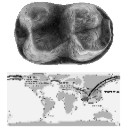
First early Eocene tapiroid from India and its implication for the paleobiogeographic origin of perissodactylsThierry Smith
Published online: 08/09/2015 |
|
|
Angolabatis nom. nov.,a replacement name for the Cretaceous genus Angolaia Antunes & Cappetta, 2002 (Chondrichthyes: Rajiformes), a preoccupied name.Miguel T. Antunes
Published online: 15/10/2006 |
|

|
The skull of Arsinoitherium (Mammalia, Embrithopoda) and the higher order interrelationships of ungulatesNicholas CourtPublished online: 17/12/1992Keywords: Arsinoitherium; PHYLOGENY; Skull; Ungulate https://doi.org/10.18563/pv.22.1.1-43 Abstract Detailed anatomical description of arsinoithere cranial remains from the Lower Oligocene, Fayum Depression, Egypt, provides the basic data for a systematic investigation. All cranial and some postcranial features are assessed from a phylogenetic standpoint. Several soft tissue characters are then added to a cladistic analysis based on 54 derived ungulate morphological characters. The resulting phylogenetic hypothesis implies that perissodactyls, sirenians, proboscideans and arsinoitheres constitute a monophyletic unit (5 synapomorphies). However, increasing the tree length by 3 steps reveals a closer association between hyraxes and perissodactyls. Nevertheless, 13 synapomorphies link proboscideans, sirenians and arsinoitheres to the exclusion of all other ungulates. Form of the sphenopalatine and ethmoid foramina, recurved posttympanic process, absence of a fenestra rotundum in the petrosal, vestigial paroccipital process of the exoccipital and the highly unusual absence of a hypoglossal foramen in the skull, imply a robust sister-group relationship between arsinoitheres and proboscideans. In this analysis artiodactyls share only one derived character with all other ungulates studied. Monophyly of Ungulata, including Artiodactyla, is therefore only weakly supported. It is argued that pedal anatomy of hyraxes is non-homologous with that of Tethytheria. Arsinoitherium should now be classified within Tethytheria, sharing a sister-group relationship with Proboscidea. Hyraxes are excluded, thus refuting the concept of Paenungulata. However, monophyly of the wider concept, Pantomesaxonia, containing hyraxes, perissodactyls, sirenians, proboscideans and now, arsinoitheres, is supported by this study. PV article infos Published in Vol. 22, Fasc. 1 (1992) |
|

|
Les rongeurs de l'Eocène inférieur et moyen d'Europe Occidentale; Systématique, phylogénie, biochronologie et paléobiogéographie des niveaux-repères MP 7 à MP 14.Gilles Escarguel
Published online: 15/12/1999 |
|

|
Cervus elaphus rossii (Mammalia, Artiodactyla), a new endemic sub-species from the Middle Pleistocene of CorsicaElisabeth PereiraPublished online: 28/12/2001Keywords: Cervus elaphus; Corsica; Endemism; Pleistocene https://doi.org/10.18563/pv.30.3-4.189-213 Abstract Several endemic deer remains from the Middle Pleistocene deposits of the Castiglione cave (Oletta, Haute-Corse) are examined here. A morphometric analysis allows to relate them to a new insular subspecies Cervus elaphus rossii. The bones were compared with those of the mainland early Middle Pleistocene subspecies Cervus elaphus acoronatus Beninde and the European species Cervus elaphus Linné (Late Middle Pleistocene and Upper Pleistocene forms (continental and insular)). The Castiglione fossil shows peculiar morphofunctional features in its appendicular skeleton suggesting a morphological convergence with certain Bovidae. PV article infos Published in Vol. 30, Fasc. 3-4 (2001) |
|

|
Une nouvelle espèce de Steneosaurus (Thalattosuchia, Teleosauridae) dans le Callovien du Poitou (France) et la systématique des Steneosaurus longirostres du Jurassique moyen d'Europe Occidentale.Patrick Vignaud
Published online: 15/09/1998 |
|

|
Contributions à l'étude du gisement miocène supérieur de Montredon (Hérault). Les grands mammifères. Avant propos.Bernard SigéPublished online: 15/11/1988Keywords: Editorial; Mammalia; Montredon; Upper Miocene https://doi.org/10.18563/pv.18.ext.1-2 Abstract Le Mémoire Extraordinaire 1988 de PALAEOVERTEBRATA regroupe dix articles consacrés au gisement à mammifères du Miocène supérieur de Montredon (Hérault), connu et classique depuis la fin du siècle dernier, et auquel est lié le nom du savant paléontologue lyonnais Charles Depéret. View editorial Published in Vol. 18, Ext (1988) |
|

|
Revision der Equoidea aus den Eozänen Braunkohlen des Geiseltales bel Halle (DDR).Jens L. Franzen and Hartmut HauboldPublished online: 15/04/1986Keywords: Eocene; Europe; Mammalia; Perissodactyla; Stratigraphy; taxonomy https://doi.org/10.18563/pv.16.1.1-34 Abstract The dentitions as well as one complete and several partial skeletons of Equoids from the Eocene lignite beds of the Geiseltal locality are revised. Instead of 13 species distinguished up to now 3 chronoclines with 5 species and 3 separate species are recognized (text. fig. 1). Propalaeotherium hassiacum HAUPT, 1925 is evolving into Propalaeotherium isselanum (CUVIER, 1824) between the levels of the « obere Unterkohle ›› and the « untere Mittelkohle ›› of the Geiseltal section. Propalaeotherium argentonicum GERVAIS, 1849 is shown to be present in the « untere Unterkohle ››, whereas Lophiotherium pygmaeum (DEPERET,1901) occurs in the « obere Mittelkohle ›› and in the « oberes Hauptmittel ››. Plagiolophus cartieri STEHLIN, 1904 appears during the transition from the « Mittelkohle ›› into the « Oberkohle ›› as the earliest true Palaeothere. Therefore the « Oberkohle ›› is already regarded as Upper Eocene. This is corroborated by the occurrence of a phyletic descendant of Propalaeatherium parvulum (Propalaeotherium n.sp.) in the middle and upper "Oberkohle " because this species appears otherwise for the first time at the mammal level of Lissieu. On the other hand Propachynolophus gaudryz (LEMOINE, 1878) described by Matthes (1977) from the « untere Unterkohle ›› turns out te be in fact a Phenacodont. Thus the decisive argument for classifying the « untere Unterkohle ›› as Lower Eocene has to be dropped. Biostratigraphically the « Unterkohle ›› and the «Basishauptrnittel ›› correspond with the lower Middle Eocene (mammal level of Messel), whereas the «unteres Hauptmittel ›› and the « untere Mittelkohle ›› are equivalent to the middle part of the middle Eocene (mammal level of lssel), and the « obere Mittelkohle ›› together with the « oberes Hauptmittel ›› coincide with the upper Middle Eocene (mammal level of Bouxwiller). PV article infos Published in Vol. 16, Fasc. 1 (1986) |
|

|
Morphotypes dentaires actuels et fossiles des chiroptères vespertilionines. 2ème partie: implications systématique et phylogéniques.Henri MenuPublished online: 15/11/1987Keywords: Chiroptera; PHYLOGENY; Systematics; Vespertilionine https://doi.org/10.18563/pv.17.3.77-150 Abstract The first part of this study was devoted to a descriptive analysis of teeth morphologies among the vespertilionine bats. This leads now to a tentative synthesis, providing views on the systematics of the group. The results could be seen according to three distinct but closely related purposes : 1 - the sorting of the genera contents in order to conform the genera units to homogeneous taxa that could represent natural issues of evolutionary lineages ; 2 - the investigation of relationships between extant genera in order to infer the possibilities of common origin ; 3 - according to the preceeding items and to the observed evolutionary trends, a tentative phylogeny, modest and cautious. The contents of many genera are sorted : Leuconoe is removed from subgeneric to generic position, whereas Myotis becomes a subgenus of it ; the myotodont species are cleared away from the Pipistrellus genus ; Glischropus and Scotozous are synonymized within Pipistrellus ; Hypsugo is raised to the generic level ; some species previously ranged within Pipistrellus will form provisionally a collective group, Attalepharca nov. ; the Eptesicus genus is broken up, the excluded species being grouped within Nycterikaupius gen. nov. ; the Nycticeini tribe is defined again after exclusion of Otonycteris , Scotoecus, Scotophilus , and addition of Hesperoptenus ; the species la io and Pipistrellus tasmaniensis are removed to Eptesicus (n.s.) and Pipistrellus dormeri to Scotoecus. Groupings of genera are stated according to the main evolutionary trends of I1/. The relevance of these is often warranted by close morphologic similarities of other teeth. This leads to a recognition of the major evolutionary radiations which occurred in the group. The filiations schematized at the end of the work show the dental relationships observed between the extant genera, and could represent a phylogenic framework. Two major facts are to be underlined : 1- the early divergence of leuconoids ; 2 - the successives crossings to myotodonty from the nyctaloid flow. Fossil data from the literature are punctually and tentatively incorporated within phylogenic sketches. PV article infos Published in Vol. 17, Fasc. 3 (1987) |
|

|
La poche à phosphate de Ste-Néboule (Lot) et sa faune de vertebres du Ludien supérieur. 12- Fissipèdes (Carnivores)Louis de Bonis
Published online: 25/09/1978 |
|
