Print ISSN: 0031-0247
Online ISSN: 2274-0333
Frequency: biannual
Notidanodon tooth (Neoselachii: Hexanchiformes) in the Late Jurassic of New Zealand
Additions to the elasmobranch fauna from the upper Cretaceous of New Jersey (middle Maastrichtian, Navesink Formation)
Fossil snakes, Palaeocene, Itaborai, Brazil, Part I
Abstract book of the 18th Conference of the EAVP
New Paleocene chimaeroid from Maryland
Eocene (57) , Quercy Phosphorites (38) , Systematics (32) , Rodents (29) , Mammalia (27)

|
Les mammifères post-glaciaires de Corse. Etude Archéozoologique.Jacques MichauxKeywords: Book reviewAbstract Les mammifères post-glaciaires de Corse. Etude Archéozoologique, par Jean-Denis Vigne, 1988. XXVle suppléments à "Gallia Préhistoire". Editions du C.N.R.S., Paris, 337 p. FRF 300. ISSN 0072-0100, ISBN 2-222-04130-9. Article infos Published in Vol. 19, Fasc. 1 (1989) |
|
|

|
The skull of Arsinoitherium (Mammalia, Embrithopoda) and the higher order interrelationships of ungulatesNicholas CourtKeywords: Arsinoitherium; PHYLOGENY; Skull; UngulateAbstract Detailed anatomical description of arsinoithere cranial remains from the Lower Oligocene, Fayum Depression, Egypt, provides the basic data for a systematic investigation. All cranial and some postcranial features are assessed from a phylogenetic standpoint. Several soft tissue characters are then added to a cladistic analysis based on 54 derived ungulate morphological characters. The resulting phylogenetic hypothesis implies that perissodactyls, sirenians, proboscideans and arsinoitheres constitute a monophyletic unit (5 synapomorphies). However, increasing the tree length by 3 steps reveals a closer association between hyraxes and perissodactyls. Nevertheless, 13 synapomorphies link proboscideans, sirenians and arsinoitheres to the exclusion of all other ungulates. Form of the sphenopalatine and ethmoid foramina, recurved posttympanic process, absence of a fenestra rotundum in the petrosal, vestigial paroccipital process of the exoccipital and the highly unusual absence of a hypoglossal foramen in the skull, imply a robust sister-group relationship between arsinoitheres and proboscideans. In this analysis artiodactyls share only one derived character with all other ungulates studied. Monophyly of Ungulata, including Artiodactyla, is therefore only weakly supported. It is argued that pedal anatomy of hyraxes is non-homologous with that of Tethytheria. Arsinoitherium should now be classified within Tethytheria, sharing a sister-group relationship with Proboscidea. Hyraxes are excluded, thus refuting the concept of Paenungulata. However, monophyly of the wider concept, Pantomesaxonia, containing hyraxes, perissodactyls, sirenians, proboscideans and now, arsinoitheres, is supported by this study. Article infos Published in Vol. 22, Fasc. 1 (1992) |
|
|

|
Observations sur l'anatomie crânienne du genre Palaeotherium (Perissodactyla, Mammalia): mise en évidence d'un nouveau sous-genre, FranzenitheriumJean-Albert RemyKeywords: Palaeotherium; Paléogène; Perissodactyla; skull anatomy; SystematicsAbstract The skull remains referred to the genus Palaeotherium are recorded and described. Biometrical tests are made to elucidate intrageneric allometric relationships and to allow comparisons with various other perissodactyls. Apart from the well known shortness of post canine diastems and deepness of the narial opening, the genus is characterized by a great lengthening of the splanchnocranium, owing to a spreading of the post-orbital facial region, by a reduced area of the eye-socket and by the prevalence of the temporal muscle with regard to the masseter; this original shape of the masticatory apparatus needs to be related to the morphology of the jugal teeth and particularly to their asymmetrical semi-hypsodonty. Article infos Published in Vol. 21, Fasc. 3-4 (1992) |
|
|

|
Perutherium altiplanense, un Notongulé du Cretacé Supérieur du PérouLarry G. Marshall, Christian de Muizon and Bernard SigéKeywords: Dental morphology; Late Cretaceous; Notoungulate; Paleobiogeography; PeruAbstract Perutherium altiplanerise THALER, 1967 from the Late Cretaceous of Peru has long been recognized as South America's oldest known placental mammal. Since its description Perutherium has been generally regarded as having condylarth affinity Based on our identification of a unique notoungulate synapomorphy we recognize Perutherium as the oldest and the most generalized known member of that order. This new determination and the large taxonomic diversity (five families) of notoungulates in rocks of Paleocene age in Argentina and Brazil, favor a South American origin for this group. The occurrence of notoungulates in rocks of Late Paleocene age in Asia and North America is explained by dispersal of a notoungulate stock from South America to North America and from there to Asia. Article infos Published in Vol. 13, Fasc. 4 (1983) |
|
|

|
La poche à phosphate de Ste-Néboule (Lot) et sa faune de vertébres du Ludien Supérieur. 2- Amphibiens. Etude PreliminaireJean-Claude Rage and Colette Vergnaud-GrazziniKeywords: Eocene; Quercy PhosphoritesAbstract The Caudata are known by two Salamandridae ; one of them is attributed to the genus Megalotriton. The Pelobatidae form the major part of the Anura ; a few bones indicate also the presence of Neobatrachia. Article infos Published in Vol. 08, Fasc. 2-4 (1978) |
|
|

|
Repartition et dynamisme des faunes de Lacertilia et d'Amphisbaenia dans l'Eocène EuropeMarc AugéKeywords: Amphisbaenia; climate; Endemism; Eocene; Europe; Lacertilia; MetabolismAbstract The composition of assemblages of lizards and Amphisbaenian from the European Eocene are described. At least ten lizard families are identified from the lower European Eocene levels. Eight are still recorded in the last level (Escamps) of the late Eocene. Agamid lizards (genus Tinosaurus) died out by the end of the lower Eocene and Varanid lizards (genus Saniwa) disappeared by the beginning of the late Eocene. Amphisbaenians are recorded throughout the Eocene in Europe. The lacertilian fossil record of Europe and North America show a high degree of faunal resemblance in the early Eocene, followed by a decrease during the later part of the epoch. The lacertilian and amphisbaenian faunas from the European Eocene are not subject to great variations during the period; this is in contrast with the mammal record at the same time. It is argued that the low metabolic rates and the ectothermy of lizards could explain those differences, along with the increasing insularity of the West European area during the late Eocene time. Article infos Published in Vol. 22, Fasc. 2-3 (1993) |
|
|
|
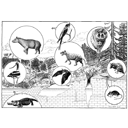
Essai de reconstitution d'un paysage du Quercy vers -35 Ma. (Esquisse de Christian Pondeville, 1977).Monique Vianey-Liaud and Christian PondevilleKeywords: Landscape reconstruction; Quercy PhosphoritesAbstract Le Quercy est aujourd'hui un vaste plateau calcaire, parcouru par un réseau karstique actif, pro· fondément entaillé par des vallées aux falaises abruptes, comme celles du Lot ou du Célé. Sur un sol peu épais domine la forêt de chênes, accompagnés de cornouillers, érables, genévriers. La faune est pauvre, peu diverse, et les nombreux chasseurs se satisfont de gibier d'élevage ... View editorial Published in Vol. 08, Fasc. 2-4 (1978) |
|
|

|
Reflections on some Russian eotheriodonts (Reptilia, Synapsida, Therapsida)Denise Sigogneau-Russell and P. K. TchudinovKeywords: Reptilia; Russia; Synapsida; Therapsidadoi: 10.18563/pv.5.3.79-109 Abstract As a result of the enrichment of eotheriodont material by one of us (P.K.T.), these specimens (essentially Biarmosuchur and Eotitanosuchur) are reexamined and refigured. A reevaluation of their particularities supports the distinction of two families, for which new diagnoses are proposed. This leads us to discuss the affinities of these families, with respect to the sphenacodonts on one hand, and to the South African primitive theriodonts on the other (gorgonopsids and ictidorhinids). This study contains inherent paleogeographic consequences which are considered in conclusion. Article infos Published in Vol. 05, Fasc. 3 (1972) |
|
|

|
Données nouvelles sur le genre Stehlinia (Vespertilionoidea, Chiroptera) du Paléocène d'EuropeBernard SigéKeywords: Chiroptera; Palaeocene; VespertilionoideaAbstract Abstract not available Article infos Published in Vol. 06, Fasc. 3-4 (1975) |
|
|

|
La poche à phosphate de Ste-Néboule (Lot) et sa faune de vertebres du Ludien supérieur. 7- Didelphides (Marsupiaux)Jean-Yves CrochetKeywords: Eocene; Quercy PhosphoritesAbstract The family Didelphidae is represented by three species in the Sainte-Néboule site, phosphorites of Quercy (lower Oligocene, San Cugat's nivel): Amphiperatherium minutum (Aymard), Amphiperatherium sp. and Peratherium cuvieri (Fischer). Only the first and third species are abundant (88 and 97 pieces). This two populations are described. The marsupial fauna of the european lower Oligocene is not recognized in its entirety in this site. Article infos Published in Vol. 08, Fasc. 2-4 (1978) |
|
|

|
Evolution des Aplodontidae Oligocènes EuropéensNorbert Schmidt-Kittler and Monique Vianey-LiaudKeywords: Aplodontidae; Europe; OligoceneAbstract Until now Aplodontidae of the European Oligocene have been documented by four species only. The phylogenetic relations remained obscure. as the distribution of only one species has been known in some detail. New material made it possible to define the stratigraphic range of two of the already existing species (Plesispermophilus angustidens, Sciurodon cadurcense) and to follow their development during the Oligocene beginning with the event of the « Grande Coupure ››. Sciurodon remained nearly without change until the end of the Middle Oligocene. Plesispermophilus angustidens split into two distinct phyletic lines, one of which (P. macrodon n. sp.) reaching considerable size, is represented till the beginning of the Upper Oligocene (Pech de Fraysse, Gaimersheim). The other line leads to Plesispermophilus ernii (basal Upper Oligocene of Burgmagerbein 1. terminal Upper Oligocene of Coderet). Besides the already known forms a new small-sized species (P. atavus n. sp.) is described, which by its primitive features closely resembles the genus Plesispermophilus. Two other small-sized species already known from the Upper Oligocene (? P. argoviensis) and Lower Miocene (? P. descedens) seem to be closely related to the new species. It cannot be decided whether they are descendents of this line or have developed independently, because of their poor fossil record. Article infos Published in Vol. 09, Fasc. 2 (1979) |
|
|

|
Prospection paléontologique de la région de Torralba de Ribota (Burdigalien du bassin de Calatayud, prov. de Zaragoza, Espagne)Edouard Boné, Maria T. Alberdi, Manuel Hoyos and Nieves Lopez-MartinezKeywords: Faunal assemblage; Macromammals; Spain; Zaragoza prov.Abstract The study of another faunal assemblage (mostly macromammals) from Torralba de Ribota (Calatayud, Zara- Article infos Published in Vol. 9, Ext (1980) |
|
|

|
First record of the genus Megaderma Geoffroy (Microchiroptera: Megadermatidae) from Australia.Suzanne J. HandKeywords: Australia; Chiroptera; Megaderma; Megadermatidae; Pliocene; Rackham's Roost Site; RiversleighAbstract A new Tertiary megadermatid is described from Rackham's Roost Site, a Pliocene limestone cave deposit on Riversleigh Station, northwestern Queensland, Australia. It appears to represent the first Australian record of Megaderma GEOFFROY, 1810, a genus otherwise known from Tertiary African and European taxa and the living Asian species M. spasma (LINNAEUS, 1758) and M. (Lyroderma) lyra PETERS, 1872. Megademza richardsi n. sp. is one of the smallest megademiatids known. It exhibits a mixture of plesiomorphic and autapomorphic features, the latter appearing to exclude it from being ancestral to any living megadermatid. The new species is one of eight megadermatids identified from the Australian fossil record, most of which are referable to Macroderma MILLER, 1906. Article infos Published in Vol. 24, Fasc. 1-2 (1995) |
|
|
|
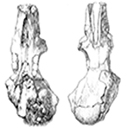
Rongeurs Miocènes dans le valles-Penedes 1 : Les rongeurs de Can Ponsic 1Jean-Louis Hartenberger and Miquel Crusafont i PairóKeywords: Can Ponsic 1; Miocene; Rodents; Valles-PenedesAbstract The rodents from the spanish locality of Can Ponsic 1 bring new data about some rodents species of the beginning of the Upper Miocene in South-West Europe. The criticims made by Mein and Freudenthal about the validity of the species Hispanomys thaleri from Can Llobateres are not justiíied. The study of the anatomy of the skull of Rotundomys from Can Ponsic 1 gives accurate information about the affinity of this genus with Cricetulus, and shows that the hypothesis, according to which Rotundomys is an ancestral form of the Arvicolids, is unlikely. The systematics of Heteroxerus and the phylogeny of the mio-pliocene Muscardinus species are also discussed. The Can Ponsic 1 locality is a little older than Can Llobateres. Article infos Published in Vol. 09, Fasc. 1 (1979) |
|
|

|
Contributions à l'étude du gisement Miocène supérieur de Montredon (Hérault). Les grands mammifères. 1 - Les LagomorphesNieves Lopez-MartinezKeywords: Lagomorpha; Montredon; Prolagus; Upper MioceneAbstract A sample of 231 isolated teeth of lagomorphs from the upper Miocene of Montredon (southern France), identified as the ochotonid Prolagus crusafonii DOPEZ, 1975, is studied, comparing it with other populations of the same species as well as with its closest species P. oeningensis (KÖNIG, 1825). Article infos Published in Vol. 18, Ext (1988) |
|
|

|
Nouvelles faunes de rongeurs de la fin Miocène inférieur en Provence. Implications géologiques et Paléogéographiques.Dominique LalaïKeywords: Biogeographic province; Biozonation; Correlation; Miocene; Palaeogeography; RodentiaAbstract Rodents from the new localities of Châteauredon (Alpes-de-Haute-Provence) and La Denise (Bouches-du-Rhône) show more similarities with the rodents known from the Czecho-Slovak locality of Franzenbad than with the species found in contemporaneous Lower Miocene faunas located westward of the present Rhône Valley. This is another data wich support the existance of several biogeographical provinces in Southern France during Lower Miocene. The correlations which have been settled down allow new datations of several formations in Provence and give new information on the Aquitanian and Burdigalian paleogeographies of this region. More precise stratigraphical allocations are given to some other localities of Central Europe. Article infos Published in Vol. 16, Fasc. 2 (1986) |
|
|
|
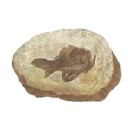
Designating a lectotype for Mesacanthus pusillus (Gnathostomata: Acanthodii)Matthew Baron and Kevin SeymourKeywords: acanthodians; Chordata; Devonian; Midland Valley; Orcadian Basindoi: 10.18563/pv.44.1.e2 Abstract The early gnathostome genus Mesacanthus is well represented in both Lower Old Red Sandstone and Middle Old Red Sandstone assemblages of northern and central Scotland. This ‘acanthodian’ taxon is currently thought to comprise two valid species: M. mitchelli and M. pusillus. Although the whereabouts of the holotype of M. mitchelli (NHMUK PV P560) is known, the syntype material for M. pusillus has long been thought lost. Here we identify at least one specimen that formed part of the original syntype material for M. pusillus, albeit in a slightly different condition than when it was originally figured. This specimen is ROM 25872, which is here designated as the lectotype. A second specimen – ELGNM 1978.191.1 – could represent another of the syntype specimens, but poor preservation quality makes it impossible to be certain. Article infos Published in 44-1 (2021) |
|
S.I. Data |

|
On the genus Dikkomys (Geomyoidea, Mammalia)Morton Green and Philip R. BjorkKeywords: Dikkomys; Geomyoidae; North AmericaAbstract The geomyoid genus Dikkomys is well represented in a sample from the Black Bear Quarry Il local fauna of Early Hemingfordian age in Bennett County, South Dakota. Isolated unworn P/4's of Dikkomys matthewi WOOD have a prominent median cristid (sagicristid) with a connection to the metaconid and the hypolophid. With wear, P/4 does not become as molariform as P/4 because of this cristid. Article infos Published in Vol. 9, Ext (1980) |
|
|

|
Les rongeurs du Miocène moyen et supérieur du MaghrebJean-Jacques JaegerKeywords: Neogene; North Africa; RodentiaAbstract The Faunas of Rodents from seven north-african fossiliferous beds distributed from the Middle up to the Uppest Miocene are studied. One genus, seventeen species, one subspecies described are new. Article infos Published in Vol. 08, Fasc. 1 (1977) |
|
|
|
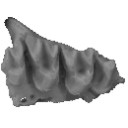
A new species of bat (Chiroptera: Vespertilionidae) from the early Oligocene global cooling period, Brule Formation, North Dakota, USANicholas Czaplewski, Jeff Person, Clint Boyd and Robert EmryKeywords: Eocene-Oligocene global cooling; Mammalia; Oligocene; Plecotini; Quinetiadoi: 10.18563/pv.42.2.e2 Abstract We report the first confirmed fossil bats from North Dakota, including a new species referable to the Vespertilionidae represented by a maxilla with P4-M3 from the Brule Formation, Fitterer Ranch local fauna, early Oligocene, Whitneyan North American Land Mammal Age. Unassociated postcranial fragments of the humerus and femur also represent a vespertilionoid, but appear to reflect a different, unidentified species. The new taxon, Quinetia frigidaria sp. nov., is referred to the genus Quinetia, previously known only from approximately contemporaneous deposits in Europe. The new species is larger than Quinetia misonnei from the early Oligocene of Belgium. It is similar in some morphological characters to Chadronycteris rabenae (Chiroptera incertae sedis) of the late Eocene (Chadronian) of northwestern Nebraska and to Stehlinia species (?Palaeochiropterygidae) from the Eocene and Oligocene of Europe, but differs from each in morphological details of the dentition and maxilla. An unassociated talonid of a lower molar from Fitterer Ranch shows myotodont morphology, unlike the nyctalodont lower molars in Q. misonnei, and thus represents a second chiropteran taxon in the fauna. Quinetia frigidaria is a member of a Paleogene radiation of bats near the low point of the Eocene-early Oligocene decline in global temperatures, increased seasonal aridity, and loss of tropical floras from mid-latitude North America. Article infos Published in Vol 42-2 (2019) |
|