|
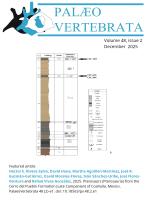
Additions to the elasmobranch assemblage from the Bandah Formation (middle Eocene, Bartonian), Jaisalmer District, Rajasthan, India, and the palaeobiogeographic implications of the fauna
Published online: 23/06/2021
Keywords:
Chondrichthyes; Elasmobranchii; Indian Ocean; Palaeogene; South Asia
https://doi.org/10.18563/pv.44.2.e1
Abstract
Isolated elasmobranch teeth (sharks and rays) from the middle Eocene (Bartonian) Bandah Formation in the Jaisalmer District of Rajasthan, India are described. The remains improve our knowledge of the environment represented by this lithostratigraphic unit and the ecology preserved therein. Seventeen unequivocal taxa were identified, including Nebrius sp., Striatolamia aff. S. macrota, Brachycarcharias atlasi, B. lerichei, cf. Jaekelotodus sp., Carcharhinus mancinae, Rhizoprionodon sp., Physogaleus sp., Galeocerdo clarkensis, G. eaglesomei, Odontorhytis aff. O. pappenheimi, “Rhinobatos” sp., “Dasyatis” sp., Coupatezia sp., “Aetomylaeus” sp., “Rhinoptera” sp., and Ouledia aff. O. lacuna. Of these, “Aetomylaeus” sp., B. atlasi, C. mancinae, G. clarkensis, G. eaglesomei, cf. Jaekelotodus sp., Nebrius sp., Odontorhytis aff. O. pappenheimi, Ouledia aff. O. lacuna, and “Rhinoptera” sp. are reported from the middle Eocene of India for the first time. The Bandah Formation elasmobranch palaeofauna has close affinities to the Palaeocene-Eocene Tethyan/Paratethyan faunas of Africa, Madagascar, Asia, and Europe, and some taxa indicate a western hemisphere influence from North America. The Bandah Formation palaeofauna indicates that deposition occurred in a moderately shallow marine environment. The Bartonian age is primarily based on foraminifera but is corroborated by the presence of elasmobranch taxa that also occur in contemporaneous deposits elsewhere. The marine regression started during the early Palaeogene, and our study indicates that the sea completely withdrew from the Jaisalmer Basin after the deposition of the Bandah Formation. This event may have been synchronous with the middle Eocene uplift of the Himalayan-Tibetan Plateau.
PV article infos
Published in 44-2 (2021)
|
PDF
|
|
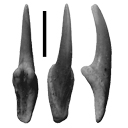
Discovery of the most ancient Notidanodon tooth (Neoselachii: Hexanchiformes) in the Late Jurassic of New Zealand. New considerations on the systematics and range of the genus
Published online: 21/09/2018
Keywords:
Chondrichthyes; Hexanchiformes; new genus; New Zealand; Tithonian
https://doi.org/10.18563/pv.42.1.e1
Abstract
This paper describes the first hexanchid tooth from the Tithonian (Late Jurassic) of New Zealand. For the moment, this tooth represents the earliest representative of the fossil genus Notidanodon in the world and one of the most ancient neoselachians in the Southern Hemisphere. Despite the perfect state of preservation of the unique tooth, the species is left in open nomenclature, pending the discovery of additional specimens. Few nominal species have been assigned to the genus Notidanodon. Four from Cretaceous deposits: N. antarcti Grande & Chatterjee, 1987, Notidanodon dentatus (Woodward, 1886), Notidanodon lanceolatus (Woodward, 1886), Notidanodon pectinatus (Agassiz, 1843) and only two from Paleocene: Notidanodon brotzeni Siverson, 1995, and Notidanodon loozi (Vincent, 1876). Considering the important morphological variations observed between some of these species, it seems obvious that the genus Notidanodon is not monophyletic and will need a revision in the future.
PV article infos
Published in Vol 42-1 (2019)
|
PDF
|
|
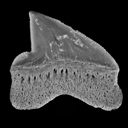
New Squalicorax species (Neoselachii: Lamniformes) from the Lower Maastrichtian of Ganntour phosphate deposit, Morocco
Published online: 05/12/2014
Keywords:
Anacoracidae; Chondrichthyes; Maastrichtian; Morocco; New taxa
https://doi.org/10.18563/pv.38.2.e3
Abstract
Two new Squalicorax species, S. benguerirensis nov. sp. and S. microserratus nov. sp. are described from the Lower Maastrichtian of the Benguérir phosphate open mine, Ganntour deposit, Morocco. The species S. benguerirensis nov. sp. was classically assigned to S. yangaensis since Arambourg (1952) and has been also recognized in coeval deposits from eastern USA to Mid-East. The species S. microserratus nov. sp. correspond to the lateral teeth of S. kaupi as reported by Arambourg (1952) and which is now referred in fact to S. bassanii. The comparison of these two new species with other Anacoracids, known in Moroccan or elsewhere, allows highlighting the great taxonomic and ecological diversities of this family during the Cretaceous.
PV article infos
Published in Vol.38-2 (2014)
|
PDF
|