Miocene Bovidae (Mammalia) of the Siwaliks: Hypsodontinae and Bovinae
Paléoenvironnement des mammifères des Gour Lazib
Pterosaurs from Coahuila
Les sélaciens du Miocène de la région de Montpellier
Contribution à l'étude des genres Gliravus et Microparamys.
Muridae du Pliocène supérieur d'Espagne et du midi de la France.
Eocene (57) , Quercy Phosphorites (38) , Systematics (32) , Rodents (29) , Mammalia (27) , Rodentia (25) , Miocene (25)
PalaeoVertebrata Vol. 07, Fasc. 3
<< prev. article next article >>

|
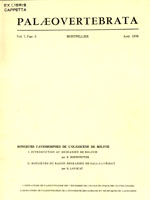
ArticleRongeurs caviomorphes de l'Oligocène de Bolivie. 1 Introduction au deseadien de BolivieRobert HoffstetterPublished online: 01/08/1976Keywords: Rodentia; South America https://doi.org/10.18563/pv.7.3.1-16 References: 11 Cited by: 3 Cite this article: Robert Hoffstetter, 1976. Rongeurs caviomorphes de l'Oligocène de Bolivie. 1 Introduction au deseadien de Bolivie. PalaeoVertebrata 7 (3): 1-16. doi: 10.18563/pv.7.3.1-16 Export citationAbstractThe Tertiary of the Salla-Luribay basin consists of red beds affected by the second period of the andine compression, of Miocene ending age. The Tertiary layers are exposed at an approximate elevation of 3.500 to 4.000 meters. Two stratigraphic units can be distinguished in them: the Luribay conglomerates, in which vertical clifts result from erosion, and the Salla layers consisting mostly of consolidated clays. These clays are very fossiliferous and have furnished a rich vertebrate fauna which gave to R. Hoffstetter the possibility to establish the Oligocene age of these beds. Sediments of same age has been reported to be present in several other places of Bolivia, particularly near Lacayani, where have been collected highly hypsodont Rodents, different from those found in Salla-Luribay basin. Published in Vol. 07, Fasc. 3 (1976) ReferencesAHLFELD (F.), 1946. — Geologia de Bolivia. Rev. Mus. La Plata (n.s.), t. III, Geologia n. 19, p. 5-370, 115 fig., 1 carte. Cited by:Jean Sudre (1979). Nouveaux Mammifères Eocènes du Sahara Occidental. PalaeoVertebrata. https://doi.org/10.18563/pv.9.3.83-115 |
|