|
The digital endocast of Necrolemur antiquus
Published online: 24/07/2020
Keywords:
brain evolution; Eocene; Omomyiforms; Primates
https://doi.org/10.18563/pv.43.2.e1
Abstract
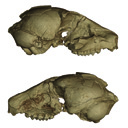
The study of endocasts, or casts of the endocranial space, have played an important role in shaping understanding of mammalian, and particularly primate, brain evolution. Recently, the reconstructions of three-dimensional virtual endocasts from high-resolution computed tomography images have allowed for the visualization and quantification of endocasts in several Paleocene and Eocene primate species. Here we present the virtual endocast of MaPhQ 289 (informally known as the Montauban 9 skull), a specimen of Necrolemur antiquus Filhol 1873, a middle to late Eocene European primate of the family Microchoeridae. The virtual endocast of MaPhQ 289 reveals a lissencephalic surface morphology with expanded temporal poles and minimal overlap of the cerebellum or olfactory bulb by the cerebrum, which closely resembles the morphology of the endocast of its contemporary relative, Microchoerus erinaceus (Primates, Microchoeridae). MaPhQ 289 yields an endocranial volume (ECV) of 2.36 cm3, about 60% smaller than the volume of the most commonly cited ECV of N. antiquus. Thus, the size of the brain of N. antiquus relative to its body size is likely to be smaller than has been reported in previous literature, highlighting the importance of corroborating older ECV estimates with new evidence using 3-D imaging techniques.
PV article infos
Published in 43-2 (2020)
|
PDF
|

|
Deux nouveaux primates dans l'Oligocène inférieur de Taqah (Sultanat d'Oman): premiers Adapiformes (?Anchomomyini) de la péninsule arabique?
Published online: 15/11/1993
Keywords:
Adapids; Afro-Arabian plate; Early Oligocene; New taxa; Primates; Trans-Tethyan dispersals
https://doi.org/10.18563/pv.22.4.141-196
Abstract
Two new species, Omanodon minor n. g., n. sp. and Shizarodon dhofarensis n. g., n. sp., known from fifteen isolated teeth, are described here as the first adapiform primates (?Anchomomyini) recognizable to date in the Taqah material (early Oligocene of Sultanate of Oman).
Omanodon minor n. g., n. sp. displays special morphological similarity to the adapid tribe Anchomomyini from the Eocene of Europe, and especially to the Anchomomys lineage. Resemblances with the extant lemurifonn Microcebus are also noticeable and could be regarded as supporting Schwartz & Tattersall (1983) hypothesis of special relationships between the anchomomyine adapids and the cheirogaleid lemuriformes. However, these morphological affmities can be interpreted, altematively, as the results of parallelisms: important differences in upper molars indicate that the resemblances of cheirogaleids and Omanodon minor n. g., n. sp. are indeed probably due to parallelisms. Phyletic relationship of O. minor n. g., n. sp. to Anchomomyini is finally the most likely hypothesis.
Shizarodon dhofarensis n. g., n. sp., although much more poorly known, is closely related to Omanodon minor n. g., n. sp., at least at a familial level. The general morphology of this species suggests
also a close link with adapid Anchomomyini, although precise relationships within this tribe remain obscure. Interesting resemblances of Shizarodon dhofarensis n. g., n. sp. to Djebelemur martinezi lower molars (early Eocene of Tunisia) are also noticeable. These resemblances are even stronger than those betwen Omanodon minor and Djebelemur martinezi. However the very bunodont upper molars referred to D. martinezi are unusual for adapids, and there are moreover some notable differences in their lower molars. Thus resemblances in Djebelemur and Shizarodon are probably due to paralellisms.
Because of the fragmentary nature of the material and of possible parallelisms, the systematic position of Omanodon and Shizarodon within adapiformes cannot however yet be established definitively.
PV article infos
Published in Vol. 22, Fasc. 4 (1993)
|
PDF
|