|
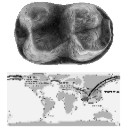
First early Eocene tapiroid from India and its implication for the paleobiogeographic origin of perissodactyls
Published online: 08/09/2015
Keywords:
Ceratomorpha; Helaletidae; Paléogène; Tapiromorpha; Vastan
https://doi.org/10.18563/pv.39.2.e5
Abstract
The presence of cambaytheres, the sister group of perissodactyls, in western India near or before the time of collision with Asia suggests that Perissodactyla may have originated on the Indian Plate during its final drift towards Asia. Herein we reinforce this hypothesis by reporting two teeth of the first early Eocene tapiromorph Perissodactyla from the Cambay Shale Formation of Vastan Lignite Mine (c. 54.5 Ma), Gujarat, western India, which we allocate to a new genus and species, Vastanolophus holbrooki. It presents plesiomorphic characters typical of the paraphyletic “Isectolophidae,” such as small size and weak lophodonty. However, the weaker hypoconulid and low paralophid, higher cusps, lower cristid obliqua, and the lingual opening of the talonid are found in Helaletidae, the most primitive tapiroid family. V. holbrooki, gen. et sp. nov., may be the oldest and the most primitive tapiroid, suggesting that at least tapiroid perissodactyls originated on India.
PV article infos
Published in Vol.39-2 (2015)
|
PDF
|
|
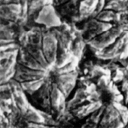
Eggshell microstructure and porosity of the Nicobar scrubfowl (Megapodius Nicobariensis, great Nicobar island, India)
Published online: 16/12/2008
Keywords:
conductance porosity; eggshell microstructure; incubation conditions; Megapodes
https://doi.org/10.18563/pv.36.1-4.75-88
Abstract
The eggshell of Nicobar scrubfowl (Megapodius nicobariensis) is described for the first time. Its egg porosity is calculated and discussed with data from several taxa (another megapode, some extant and fossil reptiles including a titanosaur group) in order to compare incubation types with eggshell structure. Eggshell microstructure reflects first phylogenetic traits and does not seem to have developed major adaptative features due to the incubation conditions, except for the pore canals.
PV article infos
Published in Vol. 36, Fasc. 1-4 (2008)
|
PDF
|

|
Middle Eocene rodents from the Subathu group, Northwest Himalya.
Published online: 15/12/1997
Keywords:
Chapattimyidae; Eocene; evolution; India; Rodentia; Subathu group; Systematics
https://doi.org/10.18563/pv.26.1-4.83-128
Abstract
Extensive collecting in previously known and new Middle Eocene rodent localities in the Subathu Group of the Rajauri and Reasi districts, Jammu and Kashmir (northwest Himalaya, India) has yielded over 500 isolated cheek teeth, numerous incisors and cheek tooth fragments, and two mandibular fragments with M/1-M/3. An analysis of this additional material and a restudy of that reported earlier from the Metka (Rajauri) area has revealed the presence of diverse Middle Eocene ctenodactyloid rodents in India. The assemblage comprises six genera and twelve species, viz.., Bírbalomys woodi, B. ibrahimshahi, B. sondaari, Basalomys vandermeuleni, B. ijlsti, B. lavocati, Chapattimys wilsoni, C. debruijni, Gumbatomys asifi, cf. Advenimus bohlini, cf. Petrokoslovia sp. indet. 1 and cf. Petrokoslovia sp. indet. 2. Most species of this assemblage are endemic to the Indian subcontinent and are referred to the Family Chapattimyidae. However, at least three taxa, viz.., cf. Advenimus bohlini, cf. Petrokoslovia sp.indet. 1 and cf. Pezrokoslovia sp. indet. 2 show close affinities with their Central and Eastern Asiatic contemporaries and are attributed to the Family Yuomyidae. The dentitions of most of the Middle Eocene rodents from India are described here in better detail thus providing more precise characterization than was available earlier. The taxonomie status of Basalomys, formerly a subgenus of Birbalomys has been raised to that of a genus. Basalomys vandermeuleni is here designated as the type species of Basalomys in place of B. ijlsti. The rodent assemblage from the Subathu Group is specifically similar to that from the coeval Kuldana Formation of Pakistan. The absence of Birbalomys ibrahimshahi and cf. Advenimus bohlini in Pakistan is related to sampling bias. The identifications of the Early Eocene rodents from Barbara Banda, Pakistan have been reexamined and the familial assignments of some of the Early and Middle Eocene rodents from Central and Eastern Asia have been discussed and reviewed in the light of recent discovery of early rodents in Mongolia.
PV article infos
Published in Vol. 26, Fasc. 1-4 (1997)
|
PDF
|