|
Article
Contributions à l'étude de l'anatomie crânienne des rongeurs. 1- Principaux types de cricétodontinés
Published online: 25/09/1967
Keywords:
Cricetodon; Cricetodontinae; Miocene
https://doi.org/10.18563/pv.1.2.47-64
References: 17
Cited by: 8
Cite this article:
Jean-Louis Hartenberger, 1967. Contributions à l'étude de l'anatomie crânienne des rongeurs. 1- Principaux types de cricétodontinés. PalaeoVertebrata 1 (2): 47-64. doi: 10.18563/pv.1.2.47-64
Export citation
Abstract
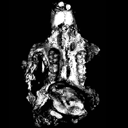
Description, for the first time, of the skull of Ruscinomys Depéret on the basis of a nearly complete specimen, and description of a new facial part of a Megacricetodon Fahlbusch skull (material from upper Miocene, Spain). New description of the skull (facial part) of " Cricetodon" incertum Schlosser on the basis of the specimen from the Oligocene of Quercy phosphorites already published by S. Schaub.
Comparison of the skull of “ C. ” incertum with that of the asiatic genus Cricetops Matthew and Granger and that of the North-American Eumys Leidy. These three genera of similar age display very distinct characteristics; their common origin must go back to the Eocene, as Wood believed.
Comparisons of the auditory regions of Ruscínomys and of Megacricetodon where important differences are noted. Comparison of the Cricetodontines from European Miocene with contemporary Cricetines. Contrary of the opinion held by Schaub, their anatomical differences do not seem suflicient to warrant the contention that none of the Cricetines derive from a form close to one of the known Cricetodontines.
Published in Vol. 01, Fasc. 2 (1967)
References
ARGYROPOULO A.-I., 1933. Die Gattungen und Arten der Hamster. Zeits. f, Saügetierkunde, 3: 129-149.
ARGYROPOULO A.-I., 1938. On the fauna of tertiary Cricetidae of the U.S.S.R. C.R. (Doklady) Acad. Sc. U.S.S.R, 20 (2-3): 223-226
EVERDEN J. F., SAVAGE D. E., CURTIS G. H., JAMES G. T., 1964. Potassium-Argon dates and the Cenozoic mammalian chronology of North America. Amer. Jour. Sc., 262: 145-198. http://dx.doi.org/10.2475/ajs.262.2.145
FAHLBUSCH V., 1964. Die Cricetiden (Mamm.) der Oberen Süsswasser Molasse Bayerns. Abh. bayerische Akad. Wiss. Mat. naturwiss. KI., N. F., 118: 1-136.
FREUDENTHAL M ., 1963. Entwiklungsstufen der miozanen Cricetodontinae (Mammalia, Rodentia) Mittelspaniens und ihre stratigraphische Bedeutung, p. 1-107, Wageningen.
GREENE E. C, 1935. Anatomy of the rat. Trans. Amer. Phil. Soc., 27: 1-370, Philadelphia. http://dx.doi.org/10.2307/1005513
GUTHRIE D. A., 1963. The carotid circulation in the Rodentia. Bull. Mus. Comp. Zool., Harvard University, 128 (10): 455-481.
HARTENBERGER J.-L., 1966. Les Cricetidae (Rodentia) de Can Llobateres (Néogène d'Espagne). Bull. Soc. Géol. Fr., 7 (7): 487-498. https://doi.org/10.2113/gssgfbull.S7-VII.3.487
HARTENBERGER J.-L., THALER L., 1963. Sur les Rongeurs fossiles du Vallésien (Miocène supérieur) de Can Llobateres (Sabadell, Espagne). C.R. Acad. Sc. Paris, 256 (15): 3333-3336.
HILL J.-E., 1935. - The cranial foramina in Rodents. Jour. Mammalogy, 16: 121-129. http://dx.doi.org/10.2307/1374358
MATTHEW W. D. and GRANGER W., 1924. Nine new rodents from the Oligocene of Mongolia. Amer. Mus. Novitales, 102: 1-10 https://doi.org/10.1002/mmnd.192419240109
MEIN P., 1966. Rotundomys, nouveau genre de Cricetidae (Mammalia, Rodentia) de la faune Néogène de Montredon (Hérault). Bull. Soc. Géol. Fr. 7 (7) : 421-425. https://doi.org/10.2113/gssgfbull.S7-VII.3.421
SCHAUB S., 1925. Die hamsterartigen Nagetiere des Tertiärs und ihre lebenden Verwandten. Abh. Schweiz. Pal. Ges., 45: 1-112, 15 fig., pl. 1-5, Bâle.
SCHAUD S., 1947. Los Cricetodontidos deI Vallès-Panadès. Estudios Geol., Inst. Lucas Mallada, 6: 56-67.
SHEVYREVA S., 1965, НОВЫЕ ОЛИГОЦЕНОВЫЕ ХОМЯКИ СССР И МОГОЛИИ. Paleont. Zh. S.S.S.R., 1: 105-114.
THALER L., 1966. Les Rongeurs fossiles du Bas-Languedoc dans leurs rapports avec l'histoire des faunes et la stratigraphie du Tertiaire d'Europe. Mém. Mus. Nat. Hist. Nat. 7, 1-295 , Paris.
WOOD A.-E, 1937. - The mammalian fauna of the White-River Oligocene. Pt 2: Rodentia. Trans. Amer. Phil. Soc., n. sér., 28 (2): 157-269, Philadelphia. https://doi.org/10.2307/1005501
|
PDF
|